SKU Complexity: The Cost Nobody Measures
Product breadth is easy to add and almost impossible to remove. Every line carries costs that never appear as a line item.
Distribution businesses accumulate SKUs the way houses accumulate objects. A customer asks for something. A manufacturer offers a new range. A salesperson wants a competitive answer. Each addition is individually reasonable.
Ten years later the catalogue has several thousand lines, a meaningful share of which have not been ordered in a year.
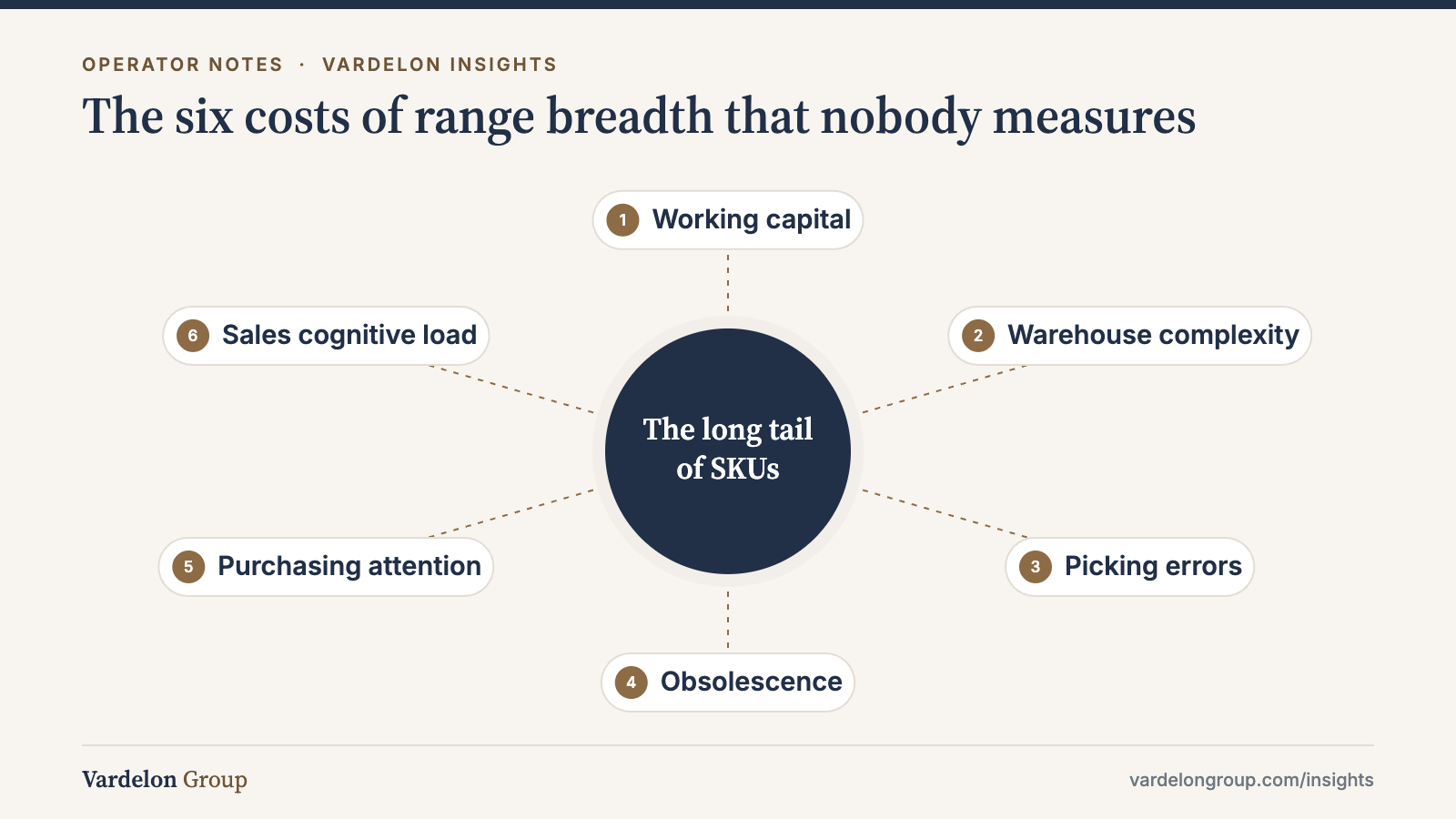
What breadth actually costs
- Working capital. Every stocked line is cash sitting on a shelf. This is the visible cost and usually the smallest one.
- Warehouse complexity. More lines means more locations, longer picking routes and more errors.
- Picking errors. A wrong item shipped to a hotel costs the delivery, the replacement, the relationship damage and the internal time to resolve it.
- Obsolescence. Specifications change, ranges are discontinued, and slow stock quietly becomes worthless.
- Purchasing attention. Someone must forecast, order and chase every line, whether it sells or not.
- Sales cognitive load. A salesperson who cannot hold the range in their head sells the part they remember.
Why the long tail persists
Because removing a line is a decision with a visible cost and an invisible benefit. Someone will complain. The saving shows up diffusely across several cost lines and is never attributed to the decision.
So the tail grows, and the business slowly becomes harder to run without anyone choosing that outcome.
What breadth is genuinely worth
This is not an argument for a narrow catalogue. Breadth has real value when it makes the supplier the easier option: one order, one delivery, one invoice, one relationship. In hospitality, where the buyer is time-poor, that convenience is worth paying for.
The distinction is between breadth that increases share of the customer’s spend and breadth that merely increases the number of things in the warehouse.
A practical test
For each line, two questions. Does anyone buy it more than occasionally? And if we stopped stocking it, would a customer buy less of something else from us?
A line that fails the first and passes the second should stay — it is a service item that protects other revenue. A line that fails both is pure cost. In most catalogues, a surprising number fail both.
The connection to scale
This is one of the areas where connected businesses can genuinely help each other. A slow line in one market may be a fast one in another. Shared visibility of what actually moves, and where, turns dead stock into a sourcing decision rather than a write-off.
It also improves purchasing: knowing real aggregate demand for a specification is a better basis for negotiation than each company guessing separately. Related: Where procurement scale actually matters →