Why Hospitality Procurement Is More Than a Price Game
Price is the most visible number in a procurement decision. It is rarely the most important one.
Ask most people how a hotel buys, and the answer involves a price list. Ask someone who has actually run the process, and the answer becomes considerably less tidy.
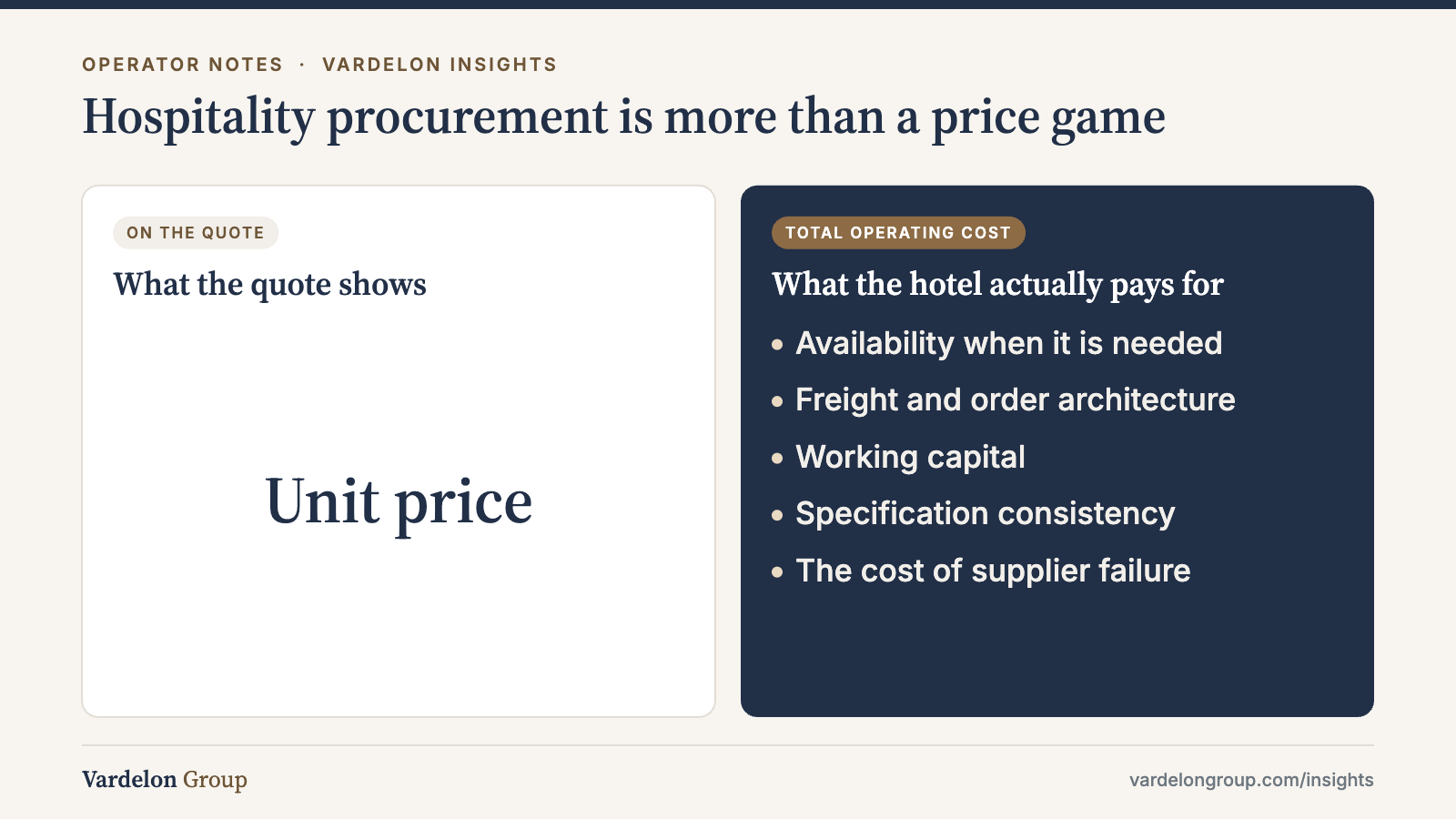
Price is real. It is also the easiest variable to compare, which is why it dominates conversations. But the true cost of a product to a hotel is assembled from a much longer list, and several of the items on that list only become visible when something goes wrong.
Unit price versus total operating cost
A cheaper towel that survives forty industrial washes instead of eighty is not cheaper. A cheaper dispenser that requires a service visit twice a year is not cheaper. A cheaper chemical that needs a higher dosing rate is frequently not cheaper at all.
None of this is exotic. It is simply that the comparison most procurement processes run — unit price against unit price — is not the comparison that determines what the hotel actually spends.
Availability has economic value
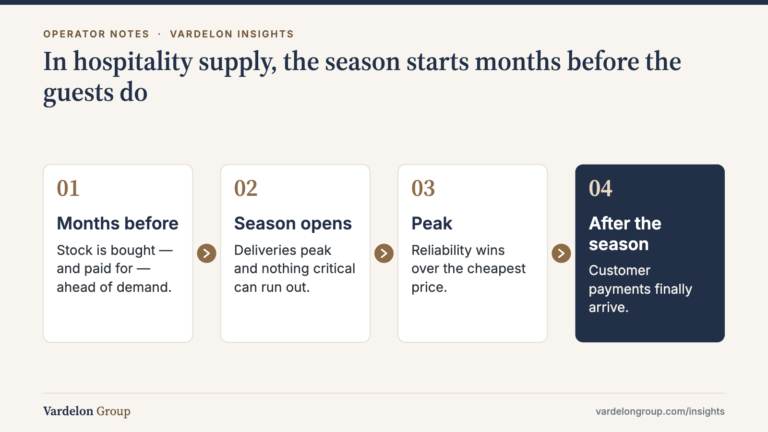
A product that is in stock is worth more than the same product at a lower price with a six-week lead time.
This is obvious in the abstract and routinely ignored in practice. A hotel that runs out of an operating consumable does not calmly wait. It sources locally at whatever price is available, absorbs the disruption, and remembers the supplier that caused it. The cost of that event rarely appears in any procurement analysis, but it is very real, and it is usually larger than the saving that created it.
Freight and order architecture
How often a customer orders, how much they order, and how the order is assembled all carry cost.
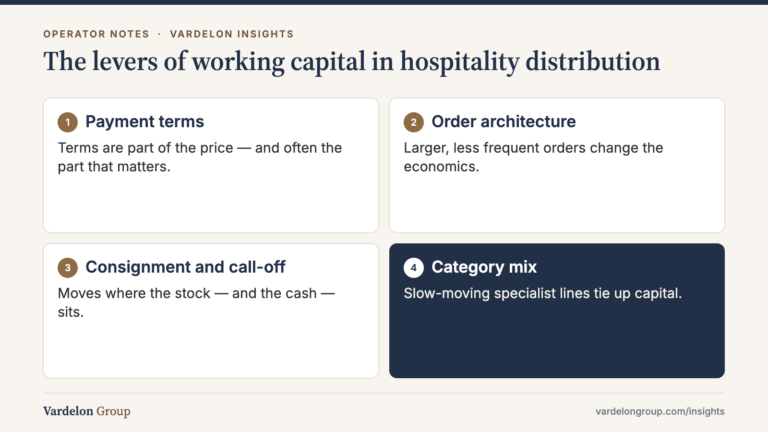
A supplier delivering weekly in small quantities is running a different business from one delivering monthly on pallets, even if the catalogue looks identical. Freight, picking, packaging and administration do not scale with the value of the goods; they scale with the number of times the process runs. Consolidating categories into fewer, larger deliveries can change the economics more than a negotiated discount.
Working capital
Stock is financed by someone. If the supplier holds it, the price reflects that. If the hotel holds it, the hotel finances it.
Payment terms, minimum order quantities and stockholding arrangements are part of the commercial package, and they are frequently worth more than the headline price. An owner-managed supplier who understands this can often construct a better deal for both sides than a larger competitor working from a rate card.
Specification consistency
For a hotel group operating several properties, having the same specification in every location has operational value: staff training, guest experience, replacement logistics and quality control all become simpler.
This is one of the areas where a supplier who can serve several properties — and, increasingly, several countries — offers something a purely local competitor cannot, without the customer having to give up local service to get it.
The cost of supplier failure
Every procurement decision carries an implicit insurance premium. What happens when the delivery is late, the equipment fails during a full house, or the specification arrives wrong two days before an opening?
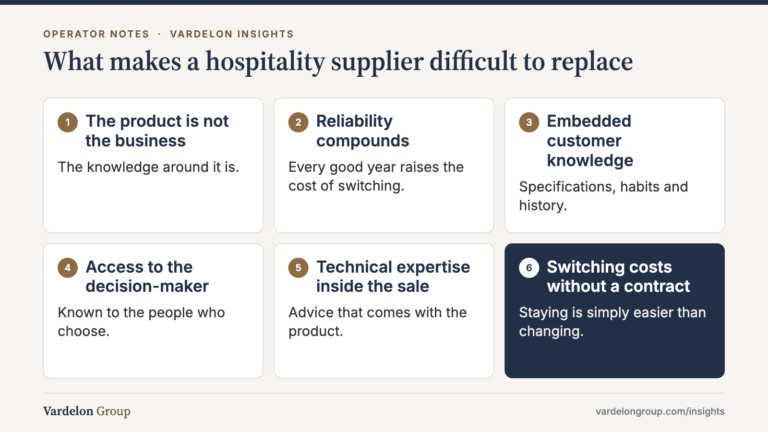
Reliability is difficult to quantify in advance and immediately obvious afterwards. It is also the single most common reason long-standing supplier relationships survive competitive pressure on price. Customers are not being irrational when they stay with a supplier who costs slightly more. They are pricing risk.
Where scale genuinely helps — and where it does not
Purchasing volume improves economics when products, specifications, manufacturers and order patterns genuinely overlap. It does much less when they do not.
Two businesses buying different specifications from different manufacturers in different quantities at different times do not automatically buy better together. Combining them produces a larger organisation, not a cheaper one. This is why procurement synergies deserve to be demonstrated category by category and supplier by supplier, rather than inserted into a model as a percentage because every acquisition plan is expected to contain them.
Why this matters
If procurement were only about price, the supplier landscape would look very different. It would be more concentrated, more centralised and considerably more boring.
It is not, because the things that determine total cost — availability, response time, specification knowledge, logistics, working capital, technical support — are largely delivered locally, by people who know the property.
That is worth remembering by anyone who looks at this market and sees only fragmentation.