Customer Borders and Supplier Borders in CEE
In Central and Eastern European hospitality, customers and suppliers increasingly operate according to different borders. That mismatch is where the strategic question sits.
One of the most interesting mismatches in Central and Eastern European hospitality is that customers and suppliers often operate according to completely different borders.
A hotel group may think regionally. Its management may compare properties across several countries. Brand standards may be shared. Procurement may increasingly be coordinated. Commercial teams may work across markets. Owners may expect similar operating standards from Budapest to Prague, Bratislava, Warsaw or Bucharest.
But the supplier base often remains organised nationally. The same hotel group can therefore behave like one regional customer while being served by several completely separate supplier ecosystems: different distributors, different contracts, different pricing, different technical teams, different brands, different inventory structures, different account managers — sometimes even completely different product specifications.
This creates a structural inconsistency. The customer thinks in terms of one operating system. The supply chain still behaves like a series of local systems.
Why this is not obviously a problem
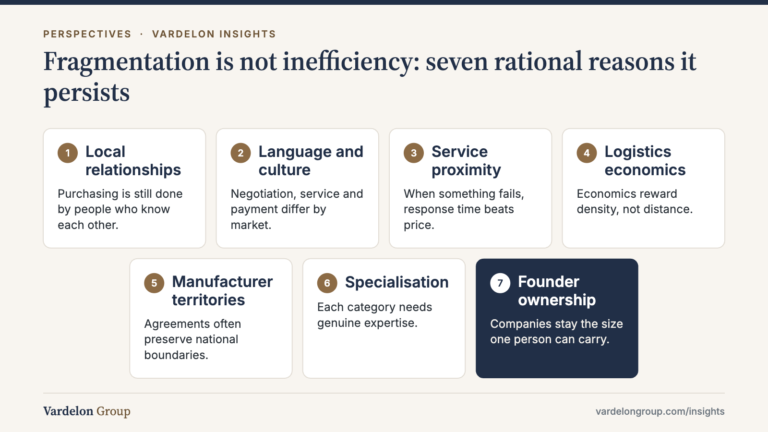
At first, this may not seem like a major issue. Hotels are local assets. Suppliers need local presence. Languages differ. Markets differ. And many strong local suppliers genuinely outperform regional alternatives.
But as hotel groups become more regional, the cost of disconnected supplier structures starts to become more visible. A regional customer may have to repeat the same supplier selection process in several countries. The same product category may be negotiated multiple times. Operational knowledge does not necessarily travel from one market to another. Successful products in one country may never reach another. Suppliers may be solving the same problems independently. Headquarters may have limited visibility across the full supplier base. And local teams may spend time rebuilding relationships that already exist elsewhere inside the same customer organisation.
It is an information problem, not only a procurement problem
A hotel group operating across several markets generates a large amount of knowledge. Which products work. Which suppliers are reliable. Which specifications create problems. Which service models are effective. Which solutions reduce operating friction.
But if supplier relationships remain completely isolated country by country, much of that learning stays local.
The same is true on the supplier side. A strong distributor may deeply understand the needs of a hotel group in Hungary. Another supplier may understand the same group in Czechia. A third may serve it in Romania. All three may hold useful information about the same customer. But there is often no structure connecting that knowledge.
The cost of duplication
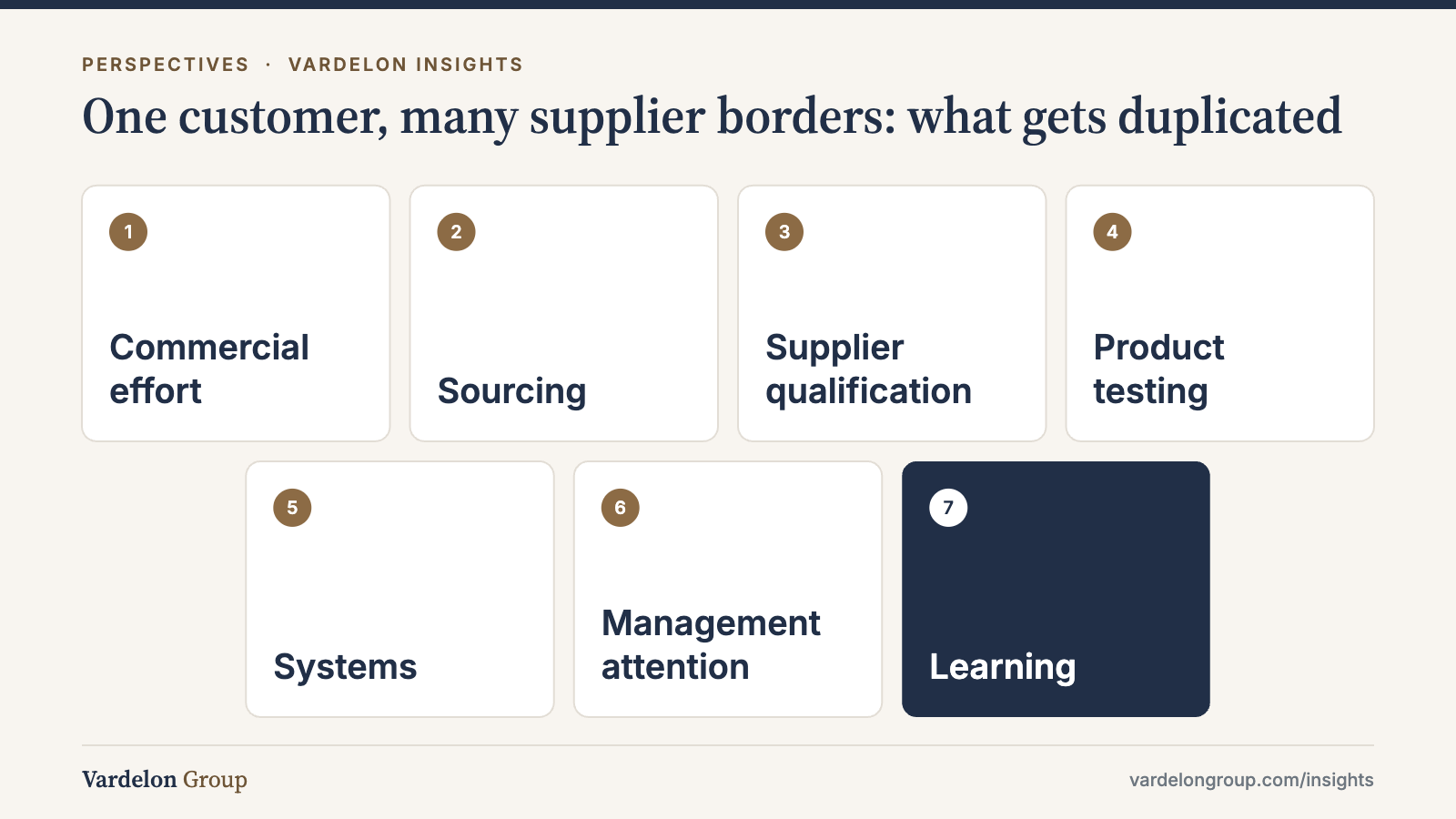
This is where the difference between customer geography and supplier geography becomes strategically important. Customers increasingly cross borders. Supplier capabilities often do not. That creates several forms of duplication.
- Duplicated commercial effort
- Duplicated sourcing
- Duplicated supplier qualification
- Duplicated product testing
- Duplicated systems
- Duplicated management attention
- Duplicated learning
Why replacing local suppliers is the wrong answer
The obvious answer would be to replace local suppliers with one regional supplier. We do not think that is necessarily the right conclusion.
The local supplier may still have the strongest customer relationship. The best market knowledge. The fastest service. The right technical team. The right manufacturer relationships. And the credibility that comes from years of local execution.
Removing that capability in the name of regional consistency can create a new problem while solving the old one.
Connect the local strengths instead
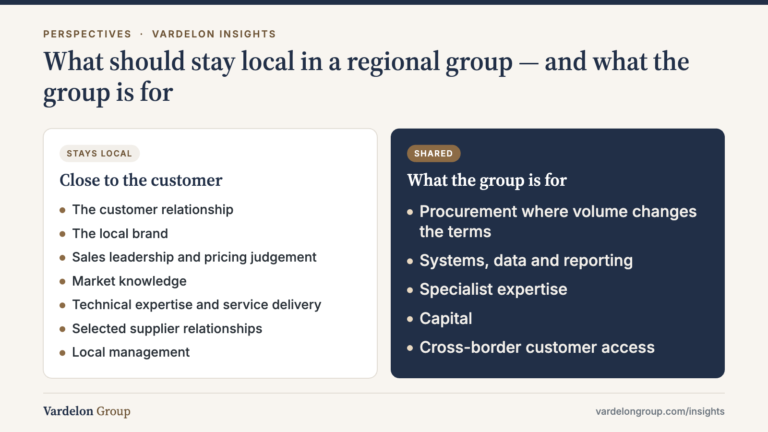
The more interesting model is to connect the local strengths. Imagine several strong local businesses serving similar hospitality customers in neighbouring countries. Each remains close to its market. Each keeps the relationships and operating capabilities that make it valuable. But selected capabilities begin to connect: customer knowledge, product access, supplier relationships, technology, data, procurement, regional account coordination, commercial intelligence, and potentially logistics where the economics make sense.
Now the customer can receive some of the advantages of regional scale without losing local service. And the local supplier can gain capabilities that would be expensive or difficult to build independently.
This is where regionalisation becomes more than simply opening offices in more countries. It becomes an architecture. The local business is still the customer-facing engine. The regional layer exists to make that engine stronger.
Start from the customer, not the map
That distinction matters because many expansion strategies begin from the wrong end. They start with geography: “Which country should we enter next?”
A better question is often: where do our existing customers already operate, and what capabilities would allow us to serve them better across those markets?
That changes the logic of expansion. Instead of pushing products into countries, the company follows customer relationships. Instead of recreating distribution from zero, it looks for strong local capability. Instead of assuming every market should operate identically, it identifies what can genuinely be shared.
Why this is particularly relevant in CEE
The region is geographically close but commercially fragmented. Countries are separated by relatively short distances. Customers may already operate across them. Manufacturers often view them as one broader region. Yet the actual route to market can remain deeply national.
That gap creates friction. It may also create opportunity. Because when customers have already become regional, the question is no longer whether their suppliers should become more connected. The question is how to build that connection without weakening the local capabilities the customer already values.
For us, that is one of the most important design questions in CEE hospitality infrastructure. The customer border is already moving. The supplier border is often still standing still.