Why CEE Hospitality Infrastructure Remains So Fragmented
Europe’s hotel industry has become increasingly regional and international. Much of the specialist infrastructure serving it has not. Understanding why requires looking beyond market size and asking what makes local supplier relationships so persistent.
A hotel guest sees a hotel. An operator sees something much more complex. Behind every property sits a network of businesses supplying the products, services and specialist capabilities required to keep it functioning: textiles, laundry, hygiene, cleaning chemicals, guest products, commercial kitchen equipment, packaging, technical systems, furniture, maintenance, procurement and distribution — and many other categories that rarely appear in conversations about the hospitality industry itself.
Collectively, these businesses form what we think of as hospitality infrastructure.
One characteristic of this market is particularly striking across Central and Eastern Europe. The customers have become increasingly regional. The suppliers often remain local.
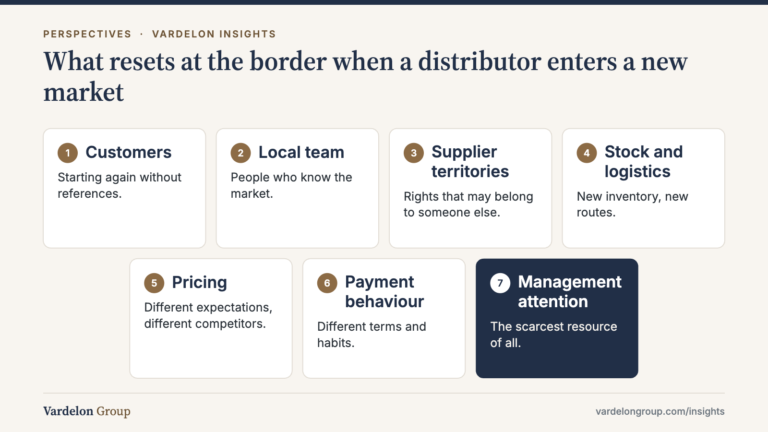
A hotel group may operate properties across several neighbouring countries with common brand standards, central reporting and increasingly coordinated procurement. Yet move behind the properties and the supplier landscape can change almost completely at every border. Different textile company. Different chemical distributor. Different equipment supplier. Different laundry. Different maintenance partner. Different commercial relationships.
At first sight, this appears inefficient. It is tempting to look at a fragmented market and conclude that the answer is consolidation. But that misses an important part of the story. CEE hospitality infrastructure remains fragmented partly because local businesses continue to solve real local problems unusually well.
Understanding the opportunity therefore requires understanding why the fragmentation exists.
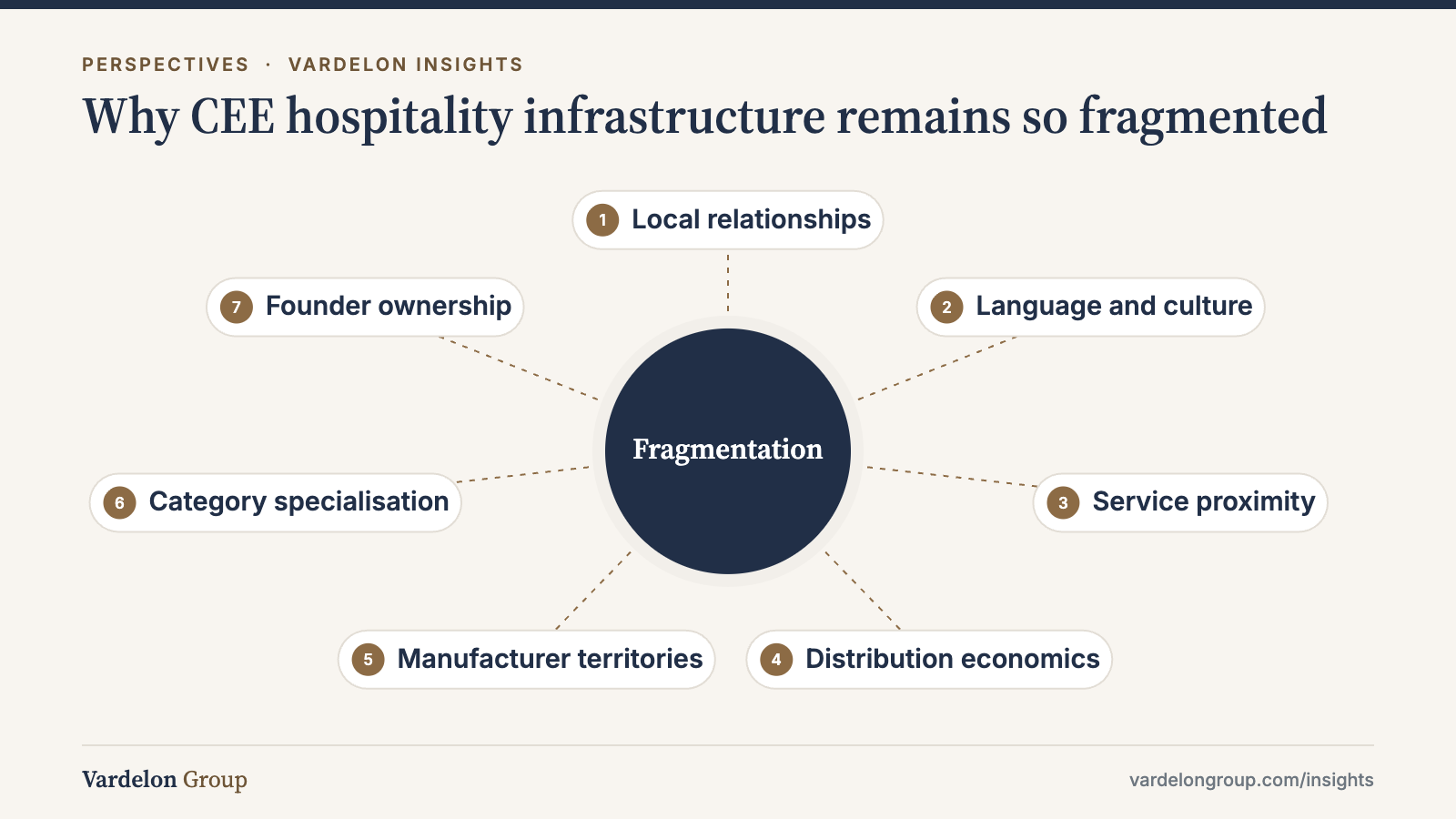
Fragmentation is not one thing
When people describe a market as fragmented, they often mean that no single company controls a large share of it. That definition is useful but incomplete. Hospitality infrastructure is fragmented across several dimensions simultaneously.
- Geographically. Companies that are important in one country may have little presence in the country next door.
- By product category. Textiles, hygiene, equipment, laundry and packaging frequently operate through separate supplier ecosystems.
- By ownership. Many businesses remain privately held and founder-led.
- By route to market. One manufacturer may work through a national distributor in one country, directly with customers in another and through several specialist dealers elsewhere.
- Operationally. Different logistics structures, service models, sales organisations, product portfolios and technology.
This produces a market that can look confusing from the outside. From inside the market, much of the structure makes sense.
Local relationships are real infrastructure
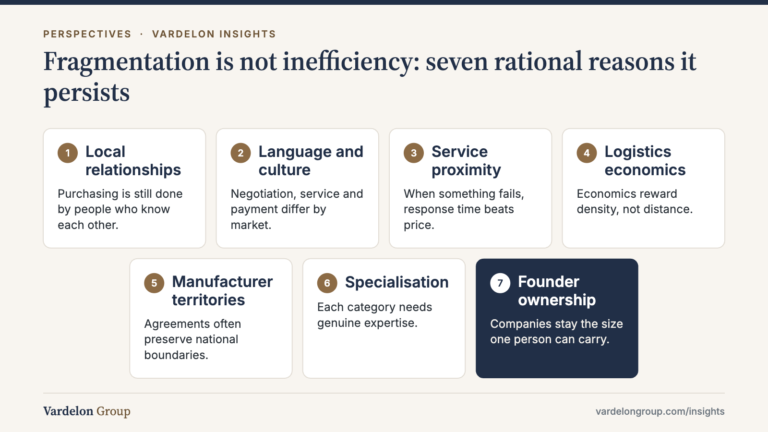
The first explanation for fragmentation is simple. B2B relationships remain local.
A good hospitality supplier does much more than move a product from a manufacturer to a hotel. It knows the customer. It understands who actually makes the purchasing decision. It knows which specifications matter, which products can be substituted and which cannot. It understands delivery expectations. It knows when the hotel is entering a peak period. It understands how problems need to be resolved.
Some of that information can sit inside a CRM system. Much of it sits inside people.
That accumulated knowledge creates an advantage that is difficult for a new entrant to reproduce quickly. A manufacturer may have a better product. A larger distributor may have more capital. An international business may have more sophisticated systems. None of that automatically creates the local trust required to win and retain a professional customer.
The supplier is not simply competing on catalogue and price. It is competing on accumulated credibility.
Language matters more than translation
European markets are geographically close but commercially distinct. Language is the obvious difference. Commercial culture is less visible.
How customers buy. Who controls purchasing. How tenders operate. What level of responsiveness customers expect. How important personal relationships are. Which payment terms are accepted. Which international brands already have strong distribution. How quickly customers switch suppliers. What level of technical support is expected.
These differences are difficult to understand from headquarters. A neighbouring country may look almost identical in a market-entry spreadsheet and feel completely different once commercial activity begins. The barrier is not the border itself. It is the knowledge accumulated on the other side of it.
Service needs proximity
Many hospitality infrastructure categories contain an operational service component. Commercial kitchens require installation and maintenance. Professional laundry equipment needs technical support. Chemical systems can require dosing equipment and training. Textile services depend on logistics and operational execution.
Equipment fails. Products run out. Hotel openings move. Specifications change. Problems rarely occur according to the supplier’s preferred timetable.
This creates value in proximity. A supplier that can respond tomorrow has an advantage over one that can theoretically offer the same service from another country next week. Regionalisation therefore cannot simply mean moving everything further away from the customer. In many categories, the local operating layer is part of the product.
Distribution economics reinforce national structures
Physical distribution has its own economics. Stock needs to be financed. Warehouses need to be located somewhere. Orders need to be picked and delivered. Freight matters. Minimum order quantities matter. Supplier territories matter. Working capital matters. Product ranges need to reflect local demand.
Some categories are highly suitable for centralised distribution. Others are not. A low-value, high-volume product behaves differently from specialist equipment. A recurring consumable behaves differently from a project-based furnishing package. A chemical business with technical dosing systems behaves differently from a linen distributor.
Talking about “hospitality supply” as one distribution model therefore hides important differences. The economically optimal footprint will vary by category.
Manufacturers helped create the fragmentation
The supplier landscape also reflects decades of manufacturer decisions. International manufacturers have traditionally entered smaller European markets through local distributors. That model solves several problems simultaneously: local sales, customer relationships, market knowledge, inventory, credit, technical support, language and, in many cases, marketing.
For the manufacturer, this can be far more efficient than building a direct organisation in every country. The consequence is a patchwork. The same international manufacturer may be represented by completely different companies across neighbouring markets. Those distributors then add other brands, categories and customer relationships.
Over time, the local distributor becomes more than a route to market for one manufacturer. It becomes a piece of commercial infrastructure in its own right.
Specialisation creates another boundary
Hospitality itself is one customer industry. Its suppliers often define themselves through product categories. A textile company thinks about textiles. A chemical distributor thinks about hygiene. An equipment supplier thinks about equipment. A packaging company thinks about foodservice packaging.
From the customer’s perspective, however, these categories coexist inside the same property. Traditional industry classifications can make businesses look unrelated even when they serve overlapping customers. The company categories may be separate. The customer relationships are not.
That creates one of the more interesting structural characteristics of hospitality infrastructure: there can be significant customer adjacency between businesses that appear to belong to entirely different industries.
Ownership matters
Another reason fragmentation persists sits outside operations. Many established B2B businesses across CEE remain closely connected to their founders or founding families.
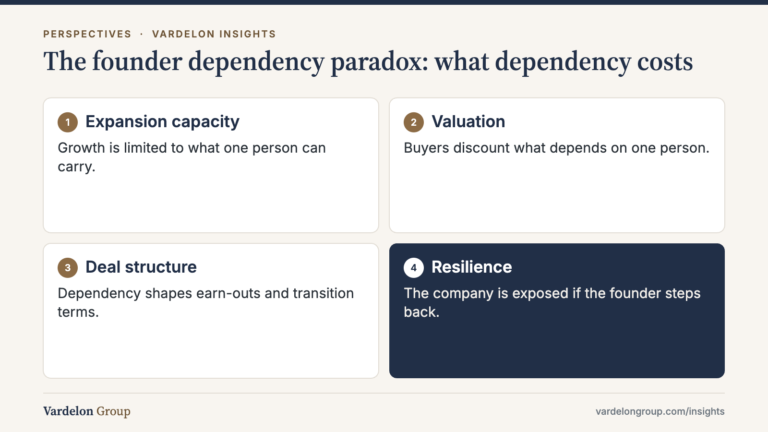
That can be an enormous strength. The founder may hold the most important customer relationships. Supplier relationships may have been developed personally over decades. The founder may understand pricing, employees, products and competitors at a level that is difficult to reproduce institutionally.
But this structure also creates constraints. International expansion requires management bandwidth. New systems require investment. Building another country organisation requires people and capital. Acquisitions require specialist capability. And eventually succession becomes relevant.
A strong company can therefore remain relatively local not because the market opportunity ends at the border, but because the organisation was designed around a different stage of development.
Fragmentation should not be mistaken for failure
The existence of many local businesses does not prove that the market is waiting for one large company to replace them. Quite the opposite. The persistence of local businesses often tells us where value actually resides: relationships, service, knowledge, speed, specialisation and local decision-making.
Any regional strategy that destroys those things in the pursuit of scale risks eliminating the reasons customers chose the company in the first place. This is where simple consolidation logic becomes dangerous. Two companies may look duplicative on an organisational chart. Their customer relationships may be anything but interchangeable.
So why is the structure becoming more interesting now?
If fragmentation has existed for decades, why should anything change? Several forces are moving simultaneously.
- Hospitality customers are becoming more regional.
- Technology is increasing the minimum level of capability expected from suppliers.
- Manufacturers want more efficient routes to market.
- Professional procurement is becoming more sophisticated.
- Management talent is expensive.
- Cross-border expansion remains difficult to build company by company.
- Ownership succession is becoming increasingly important across Europe’s SME economy.
These forces do not guarantee consolidation. But they change the economics of remaining completely isolated. A local business may still be excellent at serving its market. The question becomes whether some capabilities would be more effective if the business did not have to build them alone.
What can become better at regional scale?
Not everything. But several areas deserve attention.
Procurement
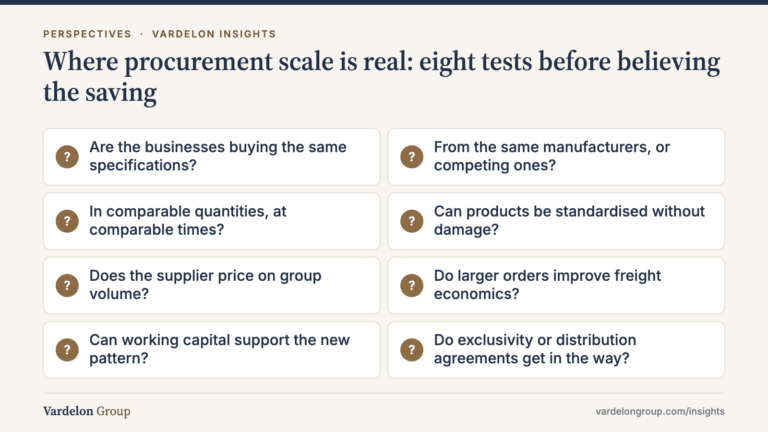
Larger purchasing volumes can improve economics where products, specifications and supplier relationships genuinely overlap.
Product access
A business in one market may have products or manufacturer relationships that can travel through another company’s customer network.
Technology
Data infrastructure, business intelligence, cybersecurity and specialist software can be disproportionately expensive for an individual SME.
Management capability
A broader organisation can support specialist functions that would be difficult for every local company to build independently.
Customer connectivity
Hotel groups operating across several countries may value suppliers capable of coordinating service across markets.
Market entry
An existing local organisation can provide a route into a market that would otherwise take years to build.
M&A capability
Sourcing, due diligence, financing and integration require skills that a strong operating SME may only need occasionally and therefore cannot justify maintaining internally.
These are not automatic synergies. They need to be demonstrated. But they illustrate why connection can create value without requiring complete centralisation.
What should often remain local?
The answer may be just as important. Customer relationships. Local sales. Market knowledge. Service delivery. Local management. Selected supplier relationships. And, in many cases, the brand.
The right structure is therefore unlikely to sit at either extreme. Not complete independence. Not complete centralisation. Something more selective. A regional organisation can provide infrastructure around strong local companies while allowing the parts of those companies that create local advantage to remain close to the customer.
The more useful question
For us, the most interesting question in CEE hospitality infrastructure is therefore not how quickly this fragmented market can be consolidated. It is this:
Which strong local capabilities should remain local, and which capabilities can become materially better when connected across a broader group?
That is a harder question. It requires understanding the businesses from the operating level rather than only from the market level. But it also leads to a more durable form of company building.
Fragmentation is not something to eliminate indiscriminately. Sometimes it contains the very strengths worth preserving. The opportunity is to determine where connection can make those businesses stronger.