The Founder Dependency Paradox
The person who made the company valuable is frequently the largest single risk to that value. Both statements are true at once.
In founder-led B2B businesses, a familiar pattern appears. The founder holds the top customer relationships, sets pricing, negotiates with the main suppliers, approves credit decisions and knows which employee to send to which account. This is not disorganisation. It is usually the reason the business works.
It is also why a buyer looks at the same company and sees concentrated risk.
How dependency accumulates
Nobody designs a company this way. It happens because the founder was, for years, genuinely the best person to do each of these things — and because delegating any one of them would have cost something in the short term.
Over three decades, a set of individually sensible decisions produces an organisation in which the most important knowledge is unwritten and the most important relationships are personal.
What it costs
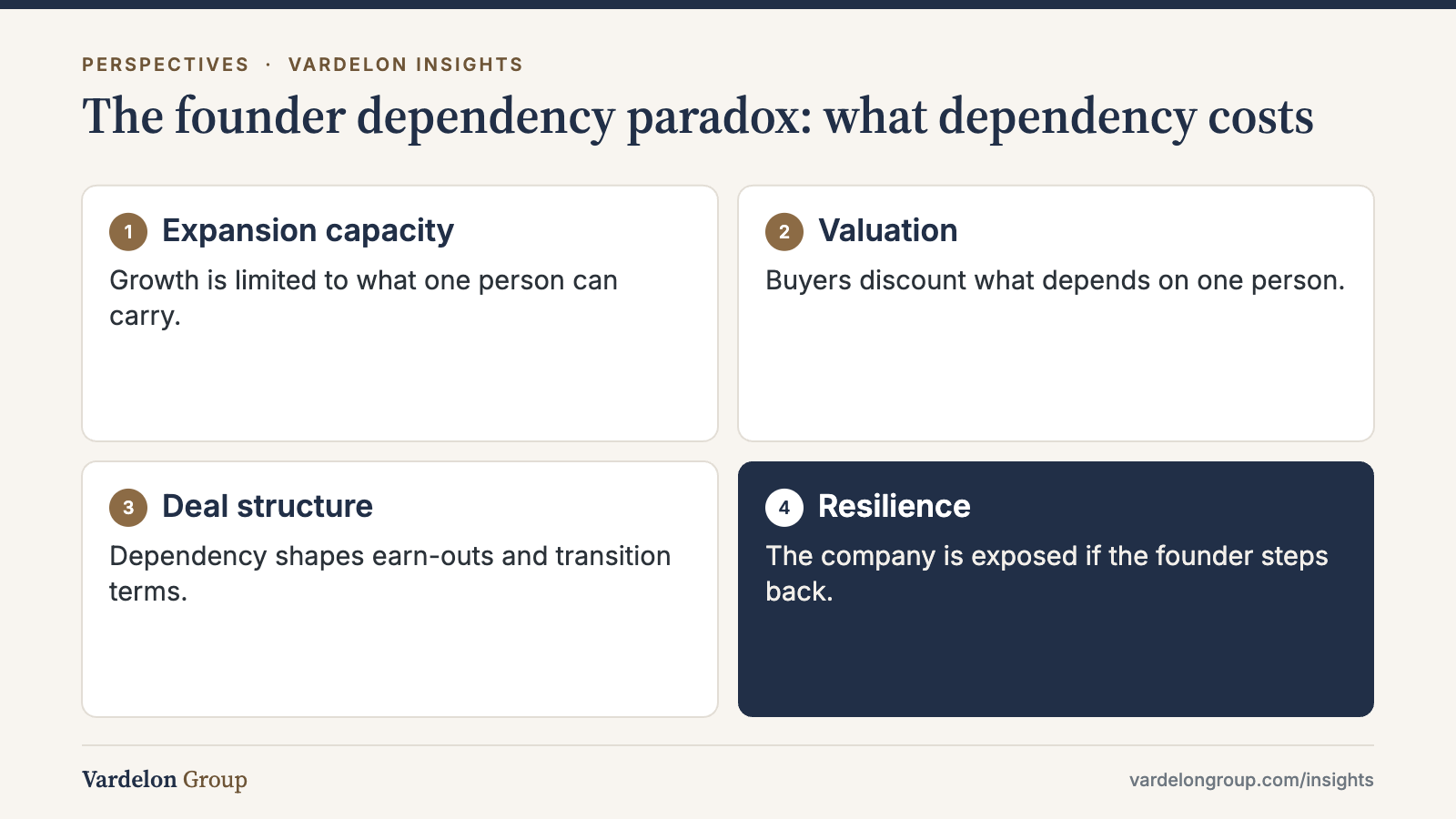
- Expansion capacity. Any growth that requires senior attention competes with the existing business for the same person.
- Valuation. Buyers discount what they cannot see transferring.
- Deal structure. Dependency tends to convert into earn-outs, longer transition periods and retained risk for the seller.
- Resilience. Illness, burnout or a single bad year affects more of the company than it should.
What reduces it without weakening the company
The useful interventions are unglamorous and take time, which is why they are worth starting long before a transaction.
Build the second layer. A commercial manager who can genuinely hold the top five accounts is worth more to eventual value than a year of margin improvement.
Make pricing explainable. Not necessarily systematised — explainable. If the logic exists only as judgement, it cannot be transferred or audited.
Introduce, deliberately. Customer relationships transfer through repeated joint contact over a long period, not through a handover meeting.
Write down what is decided informally. Credit limits, substitution rules, supplier escalation paths.
Take a proper holiday. It is the cheapest diagnostic available. What breaks in three weeks is what depends on you.
The paradox for an acquirer
An acquirer has to hold two positions simultaneously: that founder dependency is a risk to be reduced, and that the founder’s judgement is an asset to be retained.
Handled badly, this becomes a rushed removal of the person who understood the business. Handled well, it becomes a phased transition in which the founder stays involved for as long as it is useful and the organisation acquires the capabilities they were previously supplying alone.
Our preference is the second, which is why we do not require an owner to leave or to stay. More on how we work with owners →