Customer Density, Not Country Borders
Most expansion strategies begin with a map. In B2B distribution, the more useful unit of analysis is the density of customer relationships you already hold.
Ask a distribution business where it should grow and the answer usually arrives as a country. That framing is convenient, because countries are how markets are reported, how competitors are listed and how budgets are organised. It is also a poor description of how the business actually makes money.
Distribution economics are driven by density: how many customers sit close together, how often they order, how much they order at a time, and how many categories they buy from the same supplier.
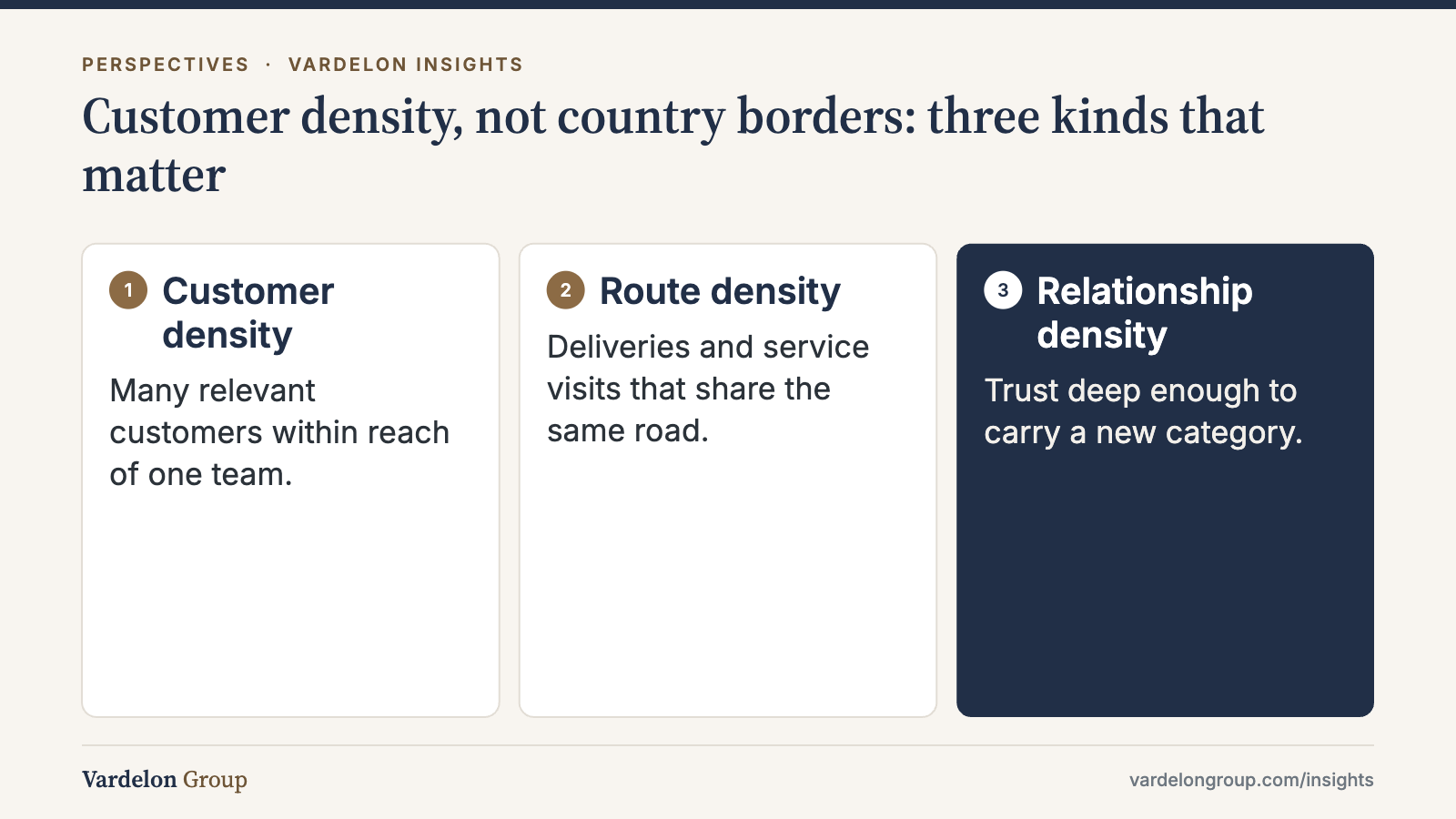
Three kinds of density
Customer density
A hundred hotels in one city is a different business from a hundred hotels spread across a country, even though the customer count is identical. Sales calls, deliveries, service visits and problem-solving all become cheaper when the customers are close to each other.
Route density
Every delivery van has a fixed cost. The variable that determines whether logistics is a strength or a drag is how many drops that van makes and how far apart they are. Route density is one of the least discussed and most decisive factors in this industry.
Relationship density
How deeply a supplier is embedded in each account: how many people it knows, how many categories it supplies, how many years of purchasing history it holds. This is what determines whether a competitor with a cheaper quote actually wins anything.
Why this changes the growth question
If density is what drives the economics, then the interesting growth options are not always in a new country. They may be in the same city.
Selling one more category to an existing customer usually costs a fraction of acquiring a new customer, and it increases every form of density at once. It deepens the relationship, improves the route, and raises the cost to a competitor of displacing you.
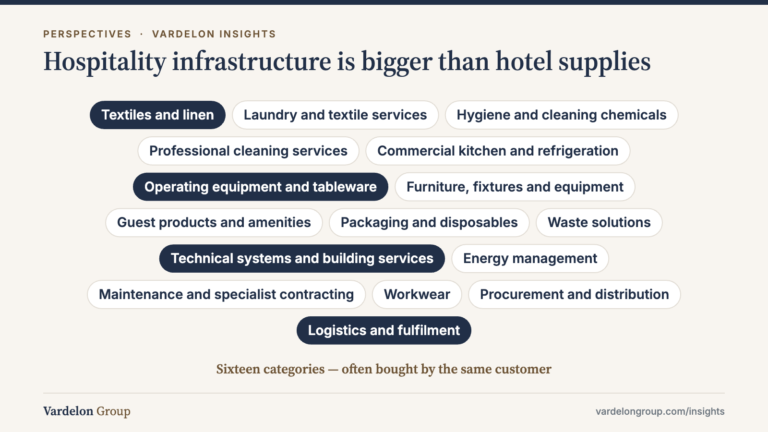
This is why we pay attention to category adjacency. Businesses classified in entirely different industries — textiles, hygiene, packaging, equipment — frequently sell to the same person, in the same building, sometimes in the same week.
Cross-selling is not automatic
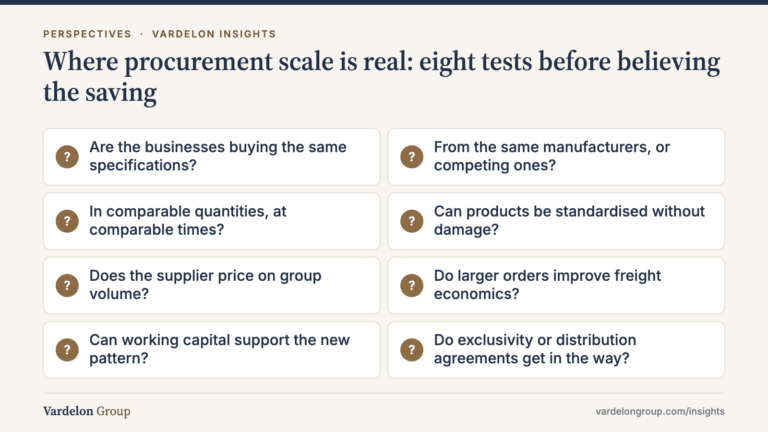
It is worth being honest about the limits. A spreadsheet can say sell company B’s products to company A’s customers in one line. Reality asks harder questions.
- Does the same person make the purchasing decision for both categories?
- Does the salesperson understand the new category well enough to be credible?
- Does the customer trust this supplier in that category, or only in the original one?
- Is the product genuinely relevant, or merely available?
- Can service quality be maintained at the same standard?
- Is the margin enough to justify the added operational complexity?
Cross-selling works when it follows the customer relationship. It fails when it follows the acquisition model.
What this implies for regional strategy
If you build around density rather than geography, market entry sequencing changes. The next market is not the biggest one or the nearest one; it is the one where your existing customers already operate, or where a category you already hold has an obvious route in.
It also changes what you look for in a partner business. Product breadth is useful. A dense, trusted customer network in a defined territory is harder to build and, in our view, worth more.
A strong customer relationship does not guarantee the next sale. But it gives you permission to earn it.
The limits of the model
Density is not a universal answer. Some categories are genuinely national or manufacturer-led, where the customer relationship sits elsewhere in the chain. Some products are bought centrally regardless of local presence. And density can become concentration risk if too much of a business depends on one cluster of customers.
But as a starting question — where are our relationships densest, and what else could travel through them? — it is considerably more useful than a map.