Manufacturer Relationships as a Strategic Asset
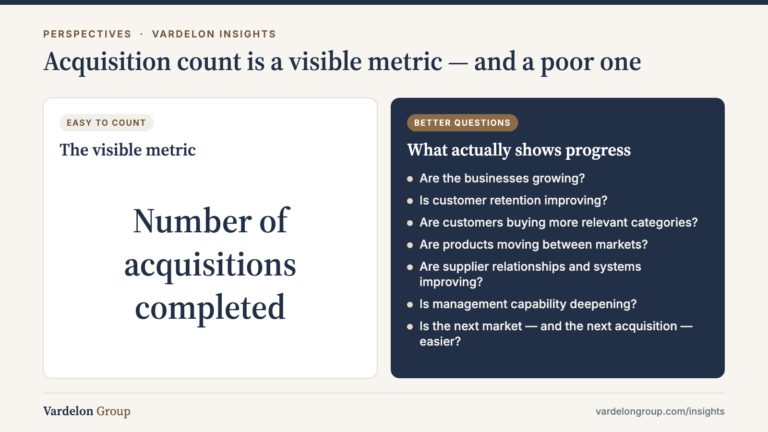
Most analysis of a distribution business looks downstream at customers. The upstream relationships are frequently where the position is actually defended.
When people assess a hospitality supplier, they look at the customer base. How many hotels, how loyal, how much they spend. That is the visible half of the business.
The other half sits upstream, and it is far less discussed: which manufacturers this company represents, on what terms, and how easily either side could walk away.
What a distribution agreement actually contains
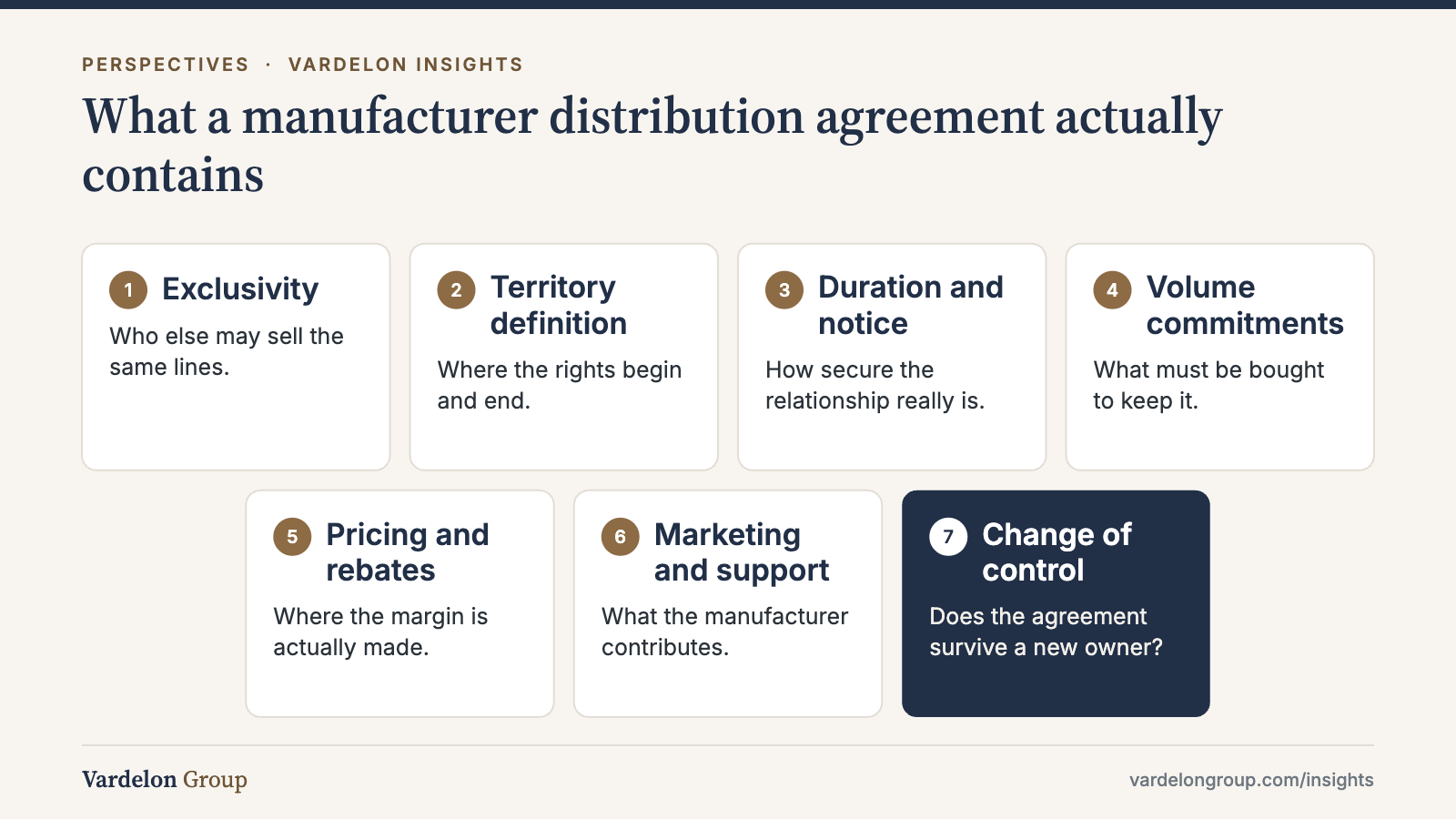
At its simplest, a manufacturer appoints a distributor to sell its products in a defined territory. Underneath that sit the terms that decide whether the arrangement is valuable or merely convenient.
- Exclusivity. Sole rights in a territory are a different asset from non-exclusive supply.
- Territory definition. Country, region, customer segment, or channel — each draws the boundary differently.
- Duration and notice. A thirty-day termination clause and a three-year term are not the same business.
- Volume commitments. Minimums that protect the manufacturer and constrain the distributor.
- Pricing and rebate structure. Where the real margin sits, often several layers below list price.
- Marketing and technical support. Training, demo equipment, spares, warranty handling.
Why manufacturers built this structure
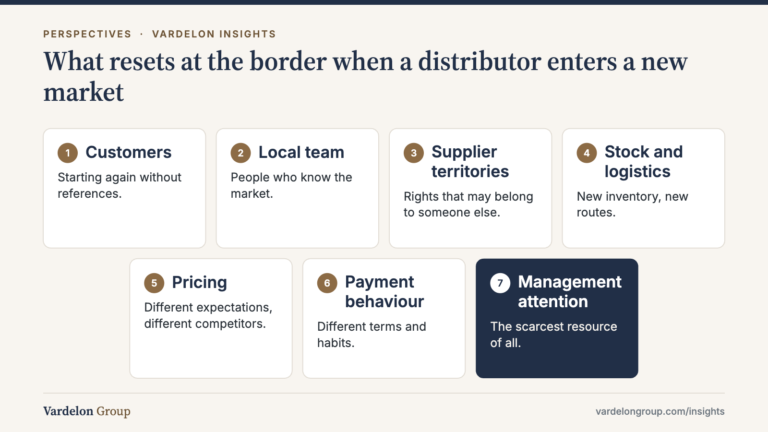
International manufacturers entering smaller European markets have historically appointed local distributors rather than building direct organisations. It solves several problems at once: local sales, customer relationships, market knowledge, inventory, credit, technical support and language, all without headcount.
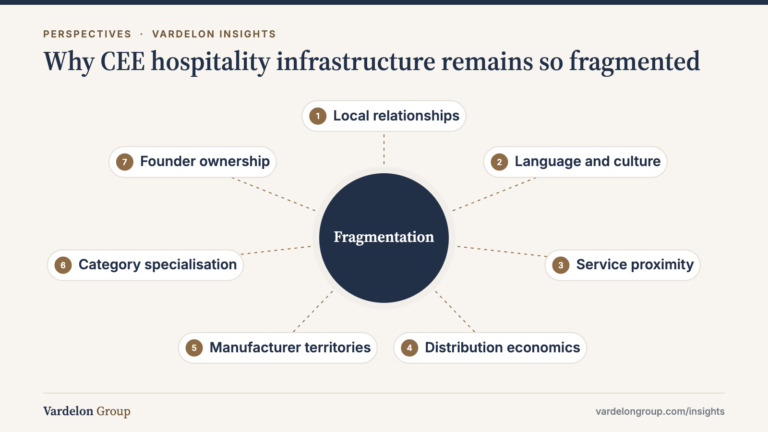
The consequence is the patchwork we described in why CEE hospitality infrastructure remains fragmented. The same manufacturer may be represented by entirely different companies in neighbouring countries, each of which then adds other brands and categories on top.
Why it matters for value
A distributor holding exclusive rights to a respected brand in a defined territory has something a competitor cannot simply outspend. The customer may want that specific product; the only route to it runs through this company.
Conversely, a distributor whose main lines are non-exclusive, terminable at short notice, or already under pressure from the manufacturer’s direct sales team has a weaker position than its revenue suggests.
This is one of the areas where a superficial look at a business and a careful one diverge most sharply.
The questions worth asking
- Which lines produce the margin, as opposed to the revenue?
- Are the key agreements exclusive, and for how long?
- What is the notice period, and has it ever been tested?
- Has the manufacturer been increasing direct engagement with end customers?
- Would the manufacturer follow this business into an ownership change, or use the moment to restructure the territory?
- Does the distributor add something the manufacturer cannot easily replace — technical service, installed base, route density?
The change-of-control question
This deserves particular attention. Many distribution agreements contain a change-of-control clause, and a manufacturer that has been considering a territory restructure may see a sale as the natural moment to act.
That risk cuts both ways. A group that manufacturers view as a more capable, better-capitalised partner across several markets may find that agreements strengthen rather than weaken — and that lines held in one country become available in another.
Where a regional group can genuinely help
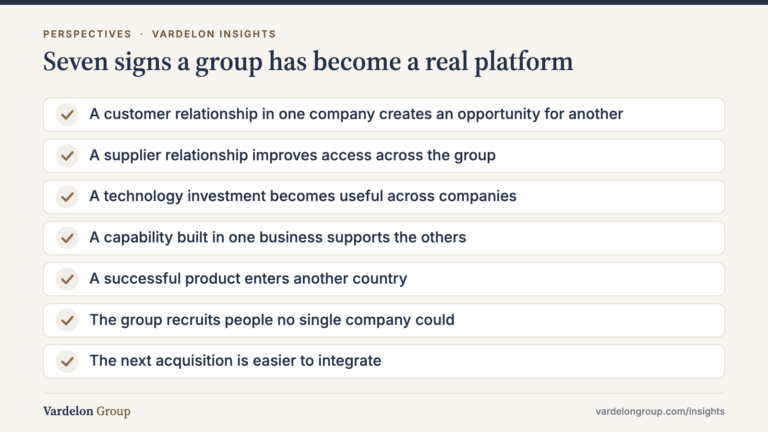
This is one of the clearer arguments for connected businesses. A manufacturer choosing between negotiating with five separate national distributors and one organisation that can cover the region coherently often prefers the second, provided local service quality is maintained.
It also works in the other direction: a product proven in one market can travel into another through an existing, trusted local organisation without the manufacturer building anything new.
That is a real advantage — but it is earned through execution rather than granted by ownership. More on how we think about this →