The Economics of Cross-Border B2B Distribution
Geographic adjacency is not commercial adjacency. Two markets can be four hours apart and require entirely separate commercial infrastructure.
Expansion decisions in B2B distribution are often made from a map. The neighbouring country is close, the customers look similar, the product is the same, and the market is large enough to matter. On that basis, entry looks straightforward.
It usually is not, and the reasons are consistent enough to be worth setting out.
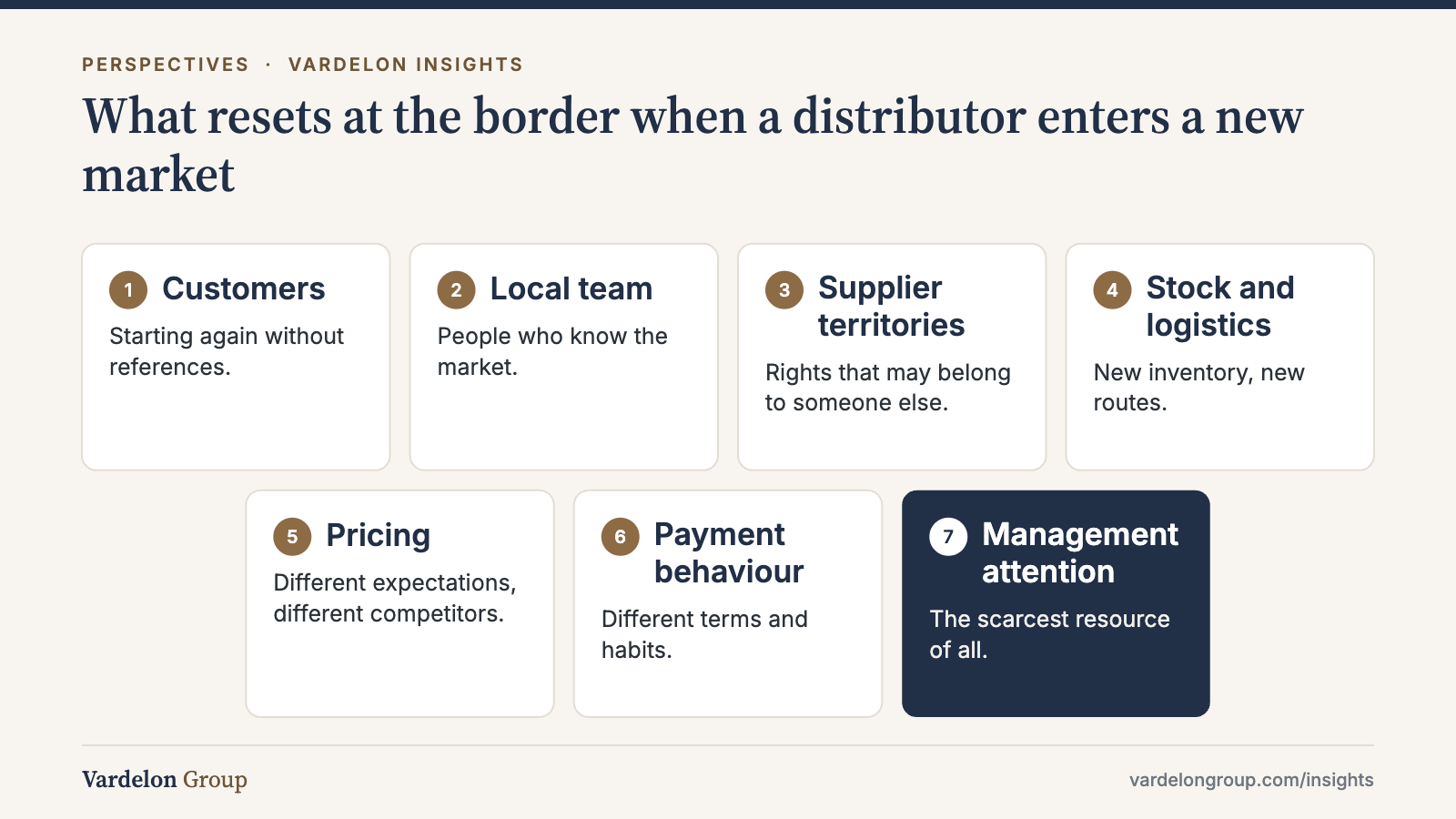
What resets at the border
A distributor operating successfully in its home market holds a set of assets that rarely appear on a balance sheet: reputation, customer references, knowledge of which competitors are serious, experienced salespeople, supplier relationships, delivery routines, pricing intuition, and a network that helps it recruit.
Cross a border and most of that resets to zero. The product is identical. The business is not.
This is why capable companies with strong domestic positions so often underperform their own expansion plans. They have solved one problem extremely well — how to operate in their market — and expansion requires solving several new problems at once, in a place where they have no accumulated advantage.
The real cost of entering a market
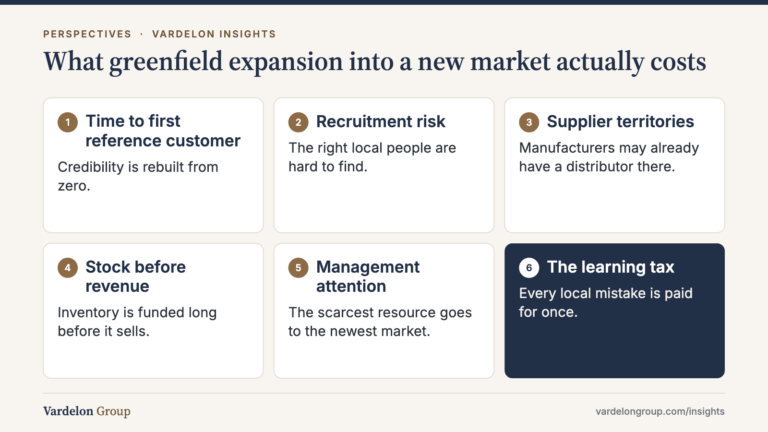
- Customer acquisition. In relationship-driven B2B, the first reference customer is disproportionately expensive. Nobody wants to be the supplier’s first hotel in the country.
- Local commercial capability. A salesperson who knows the market is expensive and difficult to hire; one who does not is cheap and ineffective.
- Supplier territories. The manufacturer whose products you distribute at home frequently has a different distributor next door, contractually.
- Stock and logistics. Delivery frequency expectations do not travel. Neither does the working capital required to meet them.
- Pricing. Comparable products can sit at materially different price points across neighbouring markets, for reasons that have nothing to do with cost.
- Payment behaviour. Terms, discipline and the practical cost of enforcement vary more than most entry plans assume.
- Management attention. The scarcest input. A new country needs leadership before it generates enough revenue to justify leadership.
Category matters more than geography
Talking about hospitality supply as a single distribution model hides important differences. A low-value, high-volume consumable behaves nothing like specialist equipment. A recurring chemical programme with installed dosing systems behaves nothing like a project-based furnishing package.
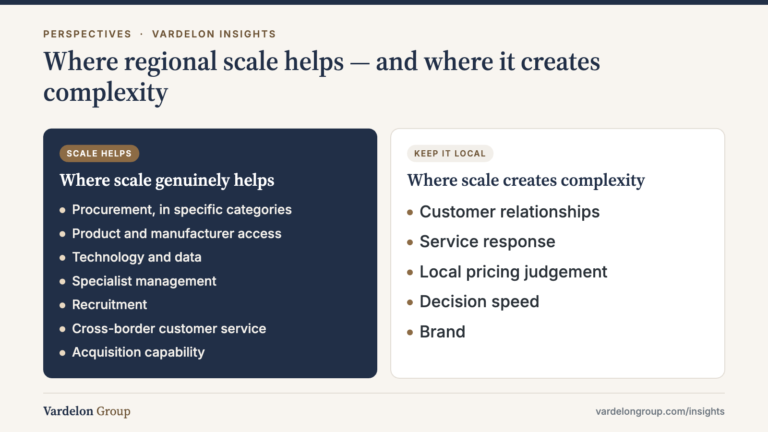
Some categories can genuinely be served from a central warehouse across several countries. Others require local stock, local engineers and local response times, and any model that assumes otherwise will look excellent until the first winter.
The practical consequence: the economically optimal footprint should be worked out category by category, not decided once for the whole company.
When greenfield entry does work
It works best where the value sits in the product rather than in the service around it, where the customer is centralised enough to be reached without a local network, where the manufacturer relationship travels, and where the company can afford to be unprofitable in that market for longer than it expects to be.
It works worst where response time is the product.
Why existing local capability changes the arithmetic
There is an alternative to building from zero: connecting to a business that has already done it.
A strong local company brings the things that are most expensive to recreate — customer relationships, reputation, market knowledge, service capability, staff who know the territory. What it frequently lacks is product breadth, systems, capital or specialist management. Those are precisely the things a broader group can supply without needing to be physically close to the customer.
That is the logic behind our view that regional scale should follow customer relationships rather than country borders. We set it out in more detail under our approach.
Instead of pushing products into countries, the company follows customer relationships.
A more useful question
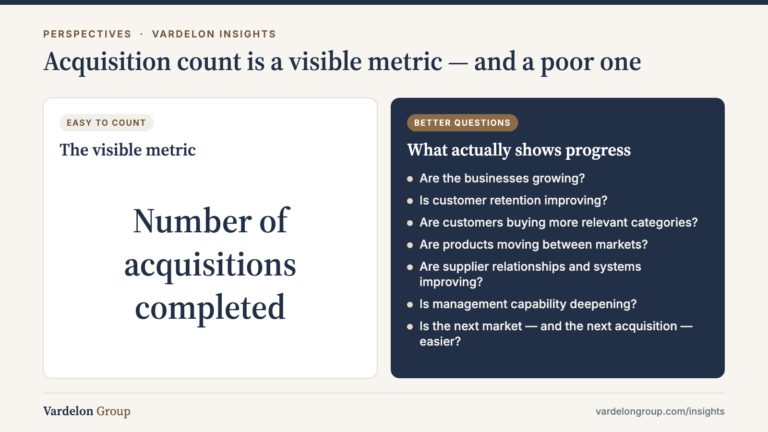
The standard expansion question is which market should we enter next? A better one is where do our customers already operate, and what capability would let us serve them better across those markets?
The first question produces a list of countries. The second produces a plan.