CEE Business Succession: The Coming Ownership Shift
A large share of Central and Eastern Europe’s private companies were founded in a single fifteen-year window. Three decades later, that timing has become a structural fact about the region.
Most discussions of company ownership in Central and Eastern Europe start with capital. We think they should start with demography.
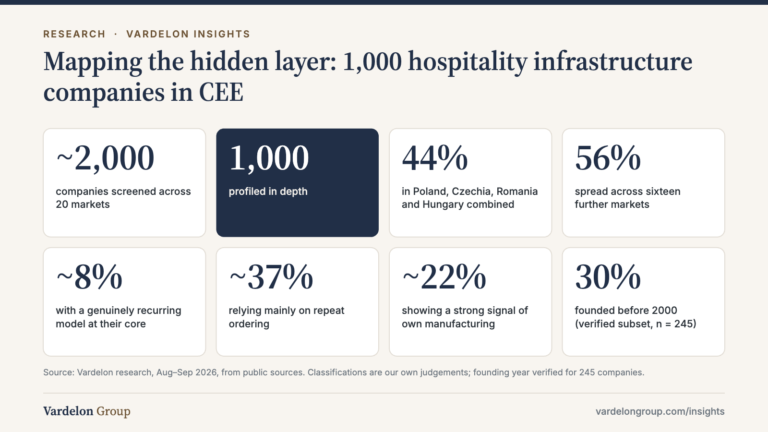
The private-company landscape across Poland, Czechia, Slovakia, Hungary, Romania and the neighbouring markets was largely created in the decade following the economic transitions of the early 1990s. A generation of founders started distribution businesses, service companies, workshops and suppliers in a compressed period, because that was when it first became possible.
Those businesses are now thirty years old. Their founders are, in many cases, in their sixties. And unlike in economies where private ownership has changed hands continuously for a century, a large share of these companies have never been transferred at all.
Why this is different from a normal succession cycle
In a mature private-company economy, ownership transitions are spread across decades. Businesses are sold, inherited, merged and wound down at a fairly constant rate, and the professional infrastructure around that — advisers, buyers, financing, precedent — is well established.
CEE is different in two ways. The first is concentration: a disproportionate number of companies reach the succession question at roughly the same time, because they were founded at roughly the same time. The second is inexperience: for many of these companies, this will be the first ownership transition in their history. There is no family precedent, no established playbook and often no adviser relationship built for the purpose.
Four routes, and why three of them frequently fail
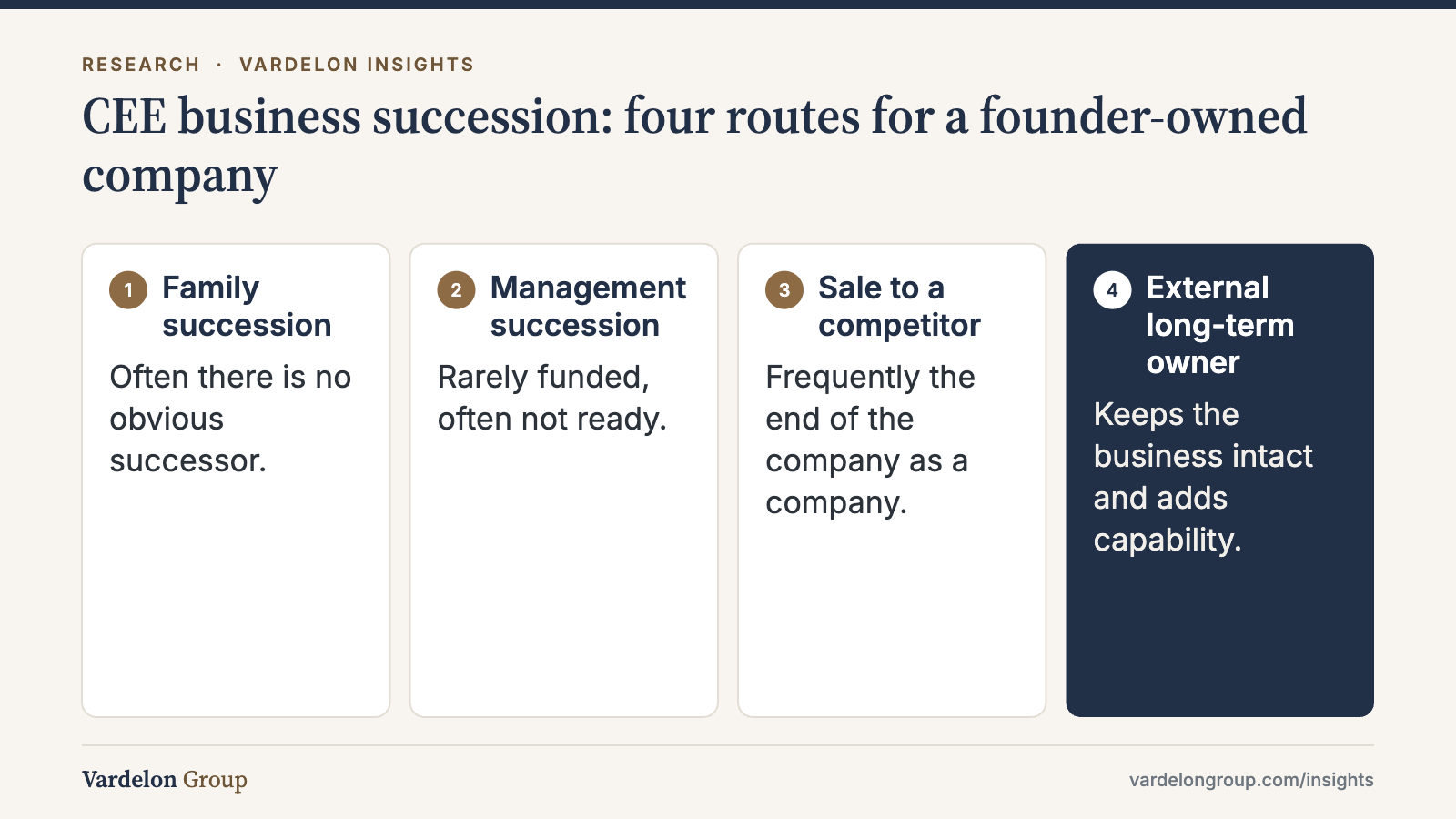
When a founder-owned business reaches this point, there are usually four possible directions.
Family succession
The most emotionally natural route and, increasingly, the least likely. The children of founders in this region are often well educated, internationally mobile and working in professions that have nothing to do with hospitality distribution or industrial services. Wanting to inherit a company and wanting to run one are different things.
Management succession
Attractive in principle, difficult in practice. It requires a management layer that is both capable and willing to take ownership risk, and financing that a management team can realistically raise. In companies where the founder has personally held the most important customer relationships for thirty years, that management layer frequently does not exist in the required depth.
Sale to a competitor
Often the fastest route to a price, and often the one owners are most uncomfortable with. A trade buyer typically buys market share. The rational thing for them to do afterwards is to consolidate overheads, rationalise the product range and absorb the customer base — which usually means the company, as a company, ceases to exist.
Sale to an external long-term owner
The route that most preserves continuity, and the one with the least developed infrastructure in this region. It requires a buyer who is genuinely interested in operating the business rather than in extracting it, and who can be credible about that intention.
Succession is an operating problem before it is a financial one
The mistake we see most often is treating succession as a valuation exercise. It is not, or at least not first.
The value of a founder-owned business is frequently concentrated in things that do not transfer automatically. The founder’s relationships with the largest customers. Their judgement about pricing. Their knowledge of which supplier will actually deliver in December. Their standing in the local market. None of these move across on completion day simply because the shares did.
Which means the practical question for an owner is not only what is my company worth but what would still be true about this business twelve months after I stopped answering the phone. That second question is answerable, and it is answerable years in advance.
What owners can do early
- Build the layer below. A commercial manager who can hold the top five customer relationships is worth more to the eventual value of the business than a year of margin improvement.
- Separate the person from the process. If pricing, sourcing or credit decisions exist only in the founder’s head, they are a risk to a buyer and a discount on the price.
- Get the reporting honest. Not more elaborate — honest. Buyers pay for information they can trust.
- Decide what actually matters to you. Continuity for staff, the survival of the brand, a role after the transaction, speed, or price. These trade against each other, and knowing the order in advance changes how a process is run.
Why this matters beyond the individual company
Taken one at a time, these are private decisions. Taken together, they are a structural event.
If a significant share of a region’s established private companies change hands within roughly a decade, the outcome shapes the industrial structure that follows. Companies absorbed by trade buyers largely disappear as independent entities. Companies with no viable route often shrink slowly rather than transfer. And companies that find a long-term owner can become the base of something larger.
This is one of the reasons we describe the opportunity in hospitality infrastructure as a company-building opportunity rather than a consolidation play. The businesses already exist. What is changing is who will own them next.
If you own or advise a business facing this question, we are always interested in a conversation →