From Local Champion to Regional Platform
A successful local business and a successful regional business are not simply different sizes of the same organisation. Moving from one to the other requires new capabilities — but not necessarily the removal of the local strengths that created success in the first place.
Some businesses are built to expand internationally from the beginning. Most established B2B companies are not. They grow one customer at a time. One supplier relationship at a time. One employee at a time. One product category at a time.
Over years, that process can create something extremely valuable: a local champion. A company that understands its market unusually well. Its customers know it. Its suppliers trust it. Employees carry years of accumulated knowledge. The founder or management team can solve problems quickly because they have seen them before. The company may not be particularly famous outside its industry. Inside its market, it matters.
Then comes a difficult question. What happens next?
The company may have room to grow. Its products may work in neighbouring markets. Its customers may already be operating across borders. Manufacturers may encourage expansion. The business may have enough capital. Yet the move from local success to regional capability often proves much more difficult than expected.
The reason is simple. A regional company is not merely a larger local company. It requires additional infrastructure.
Domestic success does not automatically travel
A strong market position creates advantages at home. It can create false confidence abroad.
At home, the company already possesses things that rarely appear on a balance sheet. Reputation. Customer references. Knowledge of competitors. Experienced salespeople. Supplier relationships. Logistics routines. Pricing intuition. Knowledge of local purchasing behaviour. A network that helps recruit people. An understanding of which customers are worth pursuing and which are not.
Enter another country and many of those advantages reset. The product remains the same. The business does not.
This explains why a company can be extremely capable domestically and still struggle with international expansion. The organisation has solved one problem very well: how to operate in its existing market. Regional expansion requires solving several new ones simultaneously.
Management bandwidth becomes a strategic resource
Founders often discover that the main constraint is not opportunity. It is attention.
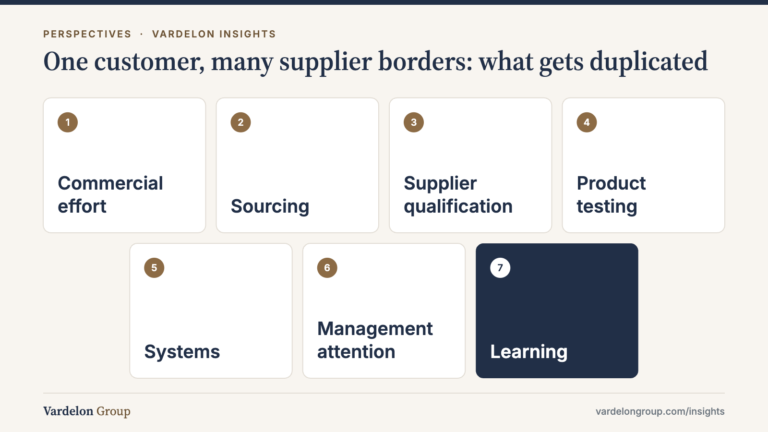
A successful B2B business already demands management time: important customers, supplier negotiations, hiring, cash flow, pricing, operational problems, product development, technology, people. Then international expansion is added to the list.
A new country requires leadership before it produces enough revenue to justify leadership. That creates an uncomfortable period in which the company must invest management capacity ahead of proven scale. For many good businesses, this is a rational reason not to expand. The expected opportunity may be attractive; the organisational risk is still too high.
The false choice
This creates a common strategic assumption. Either remain independent and local, or become part of a larger organisation and lose independence.
We think this is too binary. There is another model: a strong local business can remain close to its customers while gaining access to capabilities developed across a broader organisation. The key is deciding what belongs where.
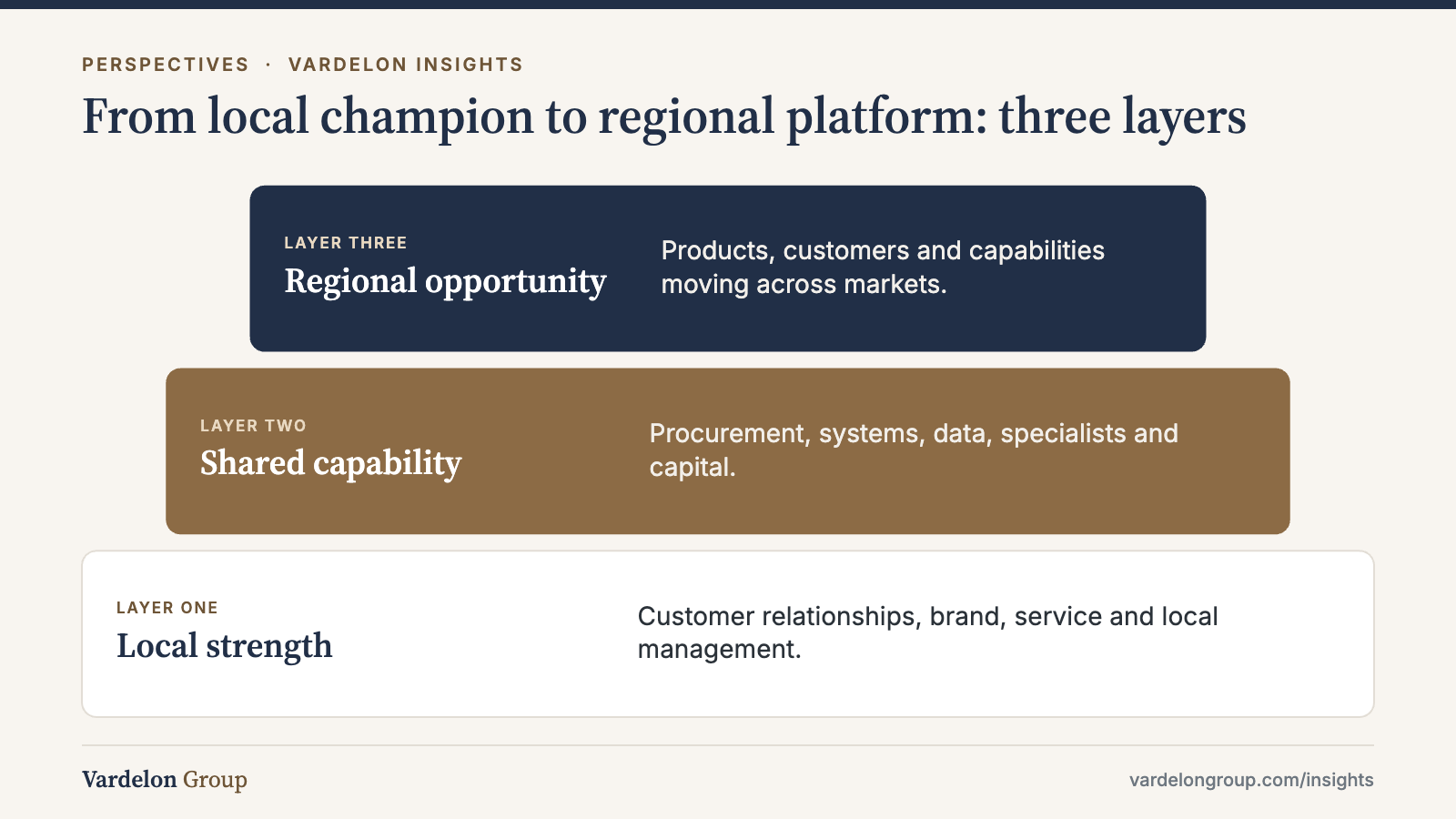
A useful regional platform can be thought about in three layers.
Layer one: local strength
This is the part of the company closest to the customer: sales, customer relationships, service delivery, local management, technical expertise, local supplier relationships, pricing judgement and the brand.
These capabilities frequently depend on proximity. Centralising them can create distance from the customer without creating an equivalent advantage elsewhere. A platform should therefore begin with the assumption that local strengths need to be understood before they are redesigned.
Layer two: shared capability
Some functions do not derive their value from physical proximity to the customer: technology, data, finance systems, cybersecurity, business intelligence, specialist procurement expertise, selected sourcing, management development, recruitment support and certain administrative capabilities.
The economics can be compelling. A technology investment that is excessive for one company may be entirely rational across several. A specialist procurement professional may create more value supporting multiple businesses than working inside one. A regional finance capability can provide better information without taking commercial decisions away from local teams.
The important point is that centralisation itself is not the objective. Capability is.
Layer three: regional opportunity
The third layer is created only because the businesses are connected. A customer relationship in one country can create an introduction in another. A strong product in one company can travel through another company’s sales network. A regional hotel group can potentially deal with connected suppliers across multiple markets. Supplier relationships can deepen. New markets can be entered using existing infrastructure. Acquisitions can be supported by an organisation that has already built the capability to execute them.
This is the layer where the platform begins to become more than a holding company.
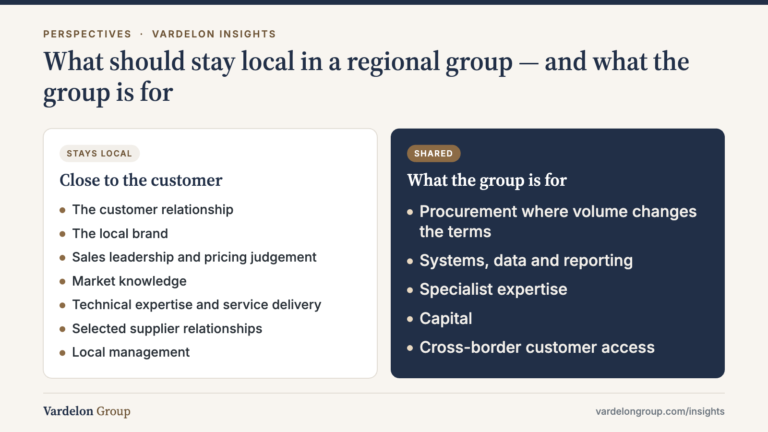
What should stay local?
There is no universal answer. But there should be a presumption in favour of preserving anything where local proximity creates genuine competitive advantage.
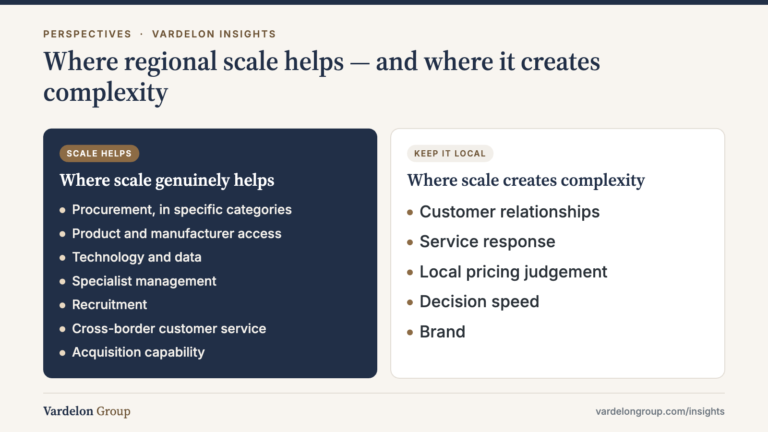
Customer relationships are the obvious example. In relationship-driven B2B markets, the salesperson or account manager is often part of the customer experience. Move too much decision-making away from them and the organisation may become slower precisely when scale was supposed to make it better.
Brand is another. A company that has operated successfully for thirty years may have accumulated trust in a name that an acquiring group cannot reproduce simply by replacing the logo. Local leadership may also matter: the person who understands a market deeply may create more value operating that market than being absorbed into a regional hierarchy.
The question should therefore not be can we centralise this? Almost anything can be centralised. The question should be will centralising this make the underlying business better? Those are very different tests.
What should become shared?
The strongest candidates usually have three characteristics. First, they are expensive to build independently. Second, their quality improves with broader scale. Third, distance from the customer does not materially reduce their effectiveness.
Technology is a good example. So are certain finance systems, specialist recruiting capability, data infrastructure, some procurement categories, management development, M&A execution and selected manufacturer relationships. The exact answer will differ by company and sector — and that is the point. A platform should not need every business to look identical in order to create common advantage.
Procurement illustrates the difference
Procurement is often the first synergy identified in an acquisition model. Sometimes correctly: if two companies buy the same products from the same manufacturers, broader volume can create meaningful leverage.
But the reality can be more complex. Specifications differ. Customer requirements differ. Supplier territories differ. Brands differ. Freight economics differ. Working capital requirements differ. Some categories can be consolidated immediately; others cannot.
A good platform therefore does not begin by promising a procurement percentage. It begins by mapping actual purchasing — category by category, supplier by supplier, country by country. Real scale is much more useful than theoretical scale.
Customer connectivity may be more valuable than purchasing power
The most interesting regional advantage may sit on the revenue side rather than the cost side.
Imagine two good local businesses in neighbouring markets. Each has spent years building customer relationships. Each understands its customers. Each has permission to have a commercial conversation with them. If their products or services are genuinely complementary, this creates possibilities — not automatic revenue, but possibility.
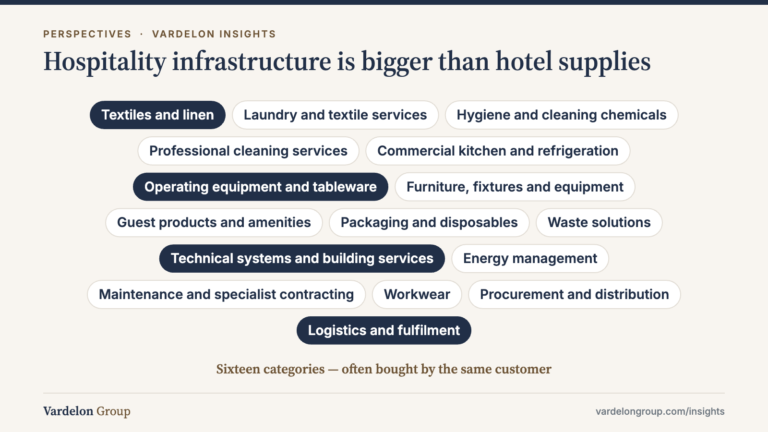
A product proven in one market can potentially reach another through an existing trusted organisation. A regional hotel customer can potentially be served more consistently. A local company can offer a broader proposition without independently building every product capability. This is why customer density and connectivity matter. The platform becomes a network rather than simply a collection of P&Ls.
A holding company is not automatically a platform
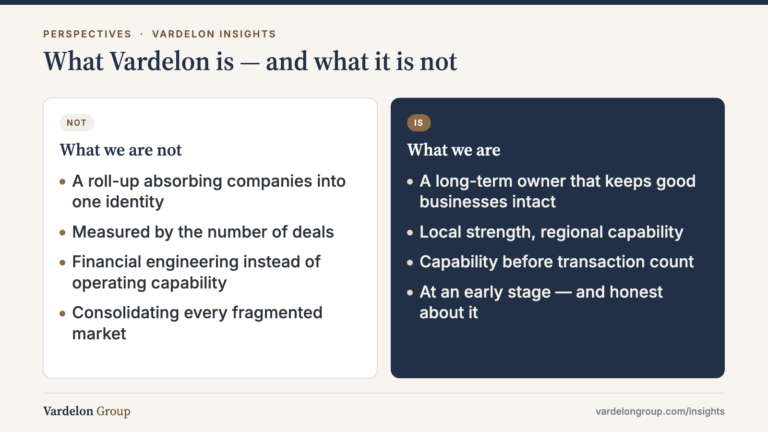
Suppose a holding company acquires five businesses. Each retains its own customers, suppliers, technology, management and commercial processes. Nothing meaningful travels between them. They may all be good companies, and the holding company may be financially successful. But operationally, very little platform capability exists.
Now imagine the same five companies beginning to connect. One company’s product reaches another’s customers. A shared sourcing capability improves supplier access. Management talent moves between businesses. Technology becomes better. A regional customer can work across multiple markets. A future acquisition plugs into infrastructure that already exists.
Something different begins to emerge. The platform is no longer defined by common ownership. It is defined by common capability.
How should platform quality be measured?
Acquisition count is an easy metric. It is also potentially misleading. Revenue is useful, but it does not tell the full story either. A stronger set of questions would be:
- Are the individual businesses growing?
- Are customer relationships strengthening?
- Are customers purchasing more relevant categories?
- Are products moving between markets?
- Are supplier relationships improving?
- Are systems becoming better?
- Is management capability becoming deeper?
- Can the organisation recruit people individual companies could not attract alone?
- Is entering the next market easier than entering the previous one?
- Does the next acquisition become more valuable because of infrastructure already built?
These questions measure whether the organisation is acquiring capability rather than simply acquiring companies.
The owner perspective matters
Business owners considering succession often care about continuity. They may have spent decades building a brand. Employees may have worked with them for years. Customers may associate the company with a particular level of service. The founder may remain emotionally connected to the business long after a transaction.
A model that assumes the company must lose its identity immediately may therefore destroy value commercially and reduce attractiveness to the owner at the same time. A regional platform can offer another proposition: the company can enter a new ownership chapter without pretending its previous chapter had no value.
That does not mean nothing changes. Businesses need to evolve. But change should have a reason.
Selective integration requires more thought, not less
Decentralisation should not become an excuse for avoiding difficult work. A weak system should not be preserved because it is local. Poor reporting should not survive because it is familiar. Management problems should not be ignored in the name of autonomy.
The principle is not do not change anything. It is understand why you are changing it. Every major integration decision creates disruption, so the expected benefit should justify the cost. In some areas the answer will be obvious. In others, patience may produce a better result.
From local champion to regional capability
The strongest local businesses often already possess the hardest thing to build: a reason for customers to care whether they exist.
Regional company building should start there. Not with the assumption that headquarters knows better. Not with an integration template. Not with an acquisition count. Start with the source of local advantage, then build around it. Technology where technology helps. Procurement where procurement helps. New products where the customer relationship supports them. Management capability where the organisation needs it. Regional access where the product can travel. Capital where good opportunities exist. And acquisitions where they add capabilities rather than simply size.
The goal is not to make every company look the same. The goal is for every company to become stronger because it is no longer building alone.
That is the difference between owning several local champions and building a regional platform.