What Makes a Hospitality Supplier Difficult to Replace?
Products are usually easy to replace. Suppliers are not. The difference between the two is where most of the value in B2B distribution actually sits.
There is a version of this industry that exists only on paper. In it, a hotel needs a product, several companies offer that product, and the hotel selects one. Switching is a matter of signing with someone else.
Anyone who has worked inside these businesses knows the paper version is wrong. Suppliers who look entirely replaceable on a catalogue page turn out to be extremely difficult to replace in practice. Understanding why is, in our view, one of the more useful things you can know about this market.
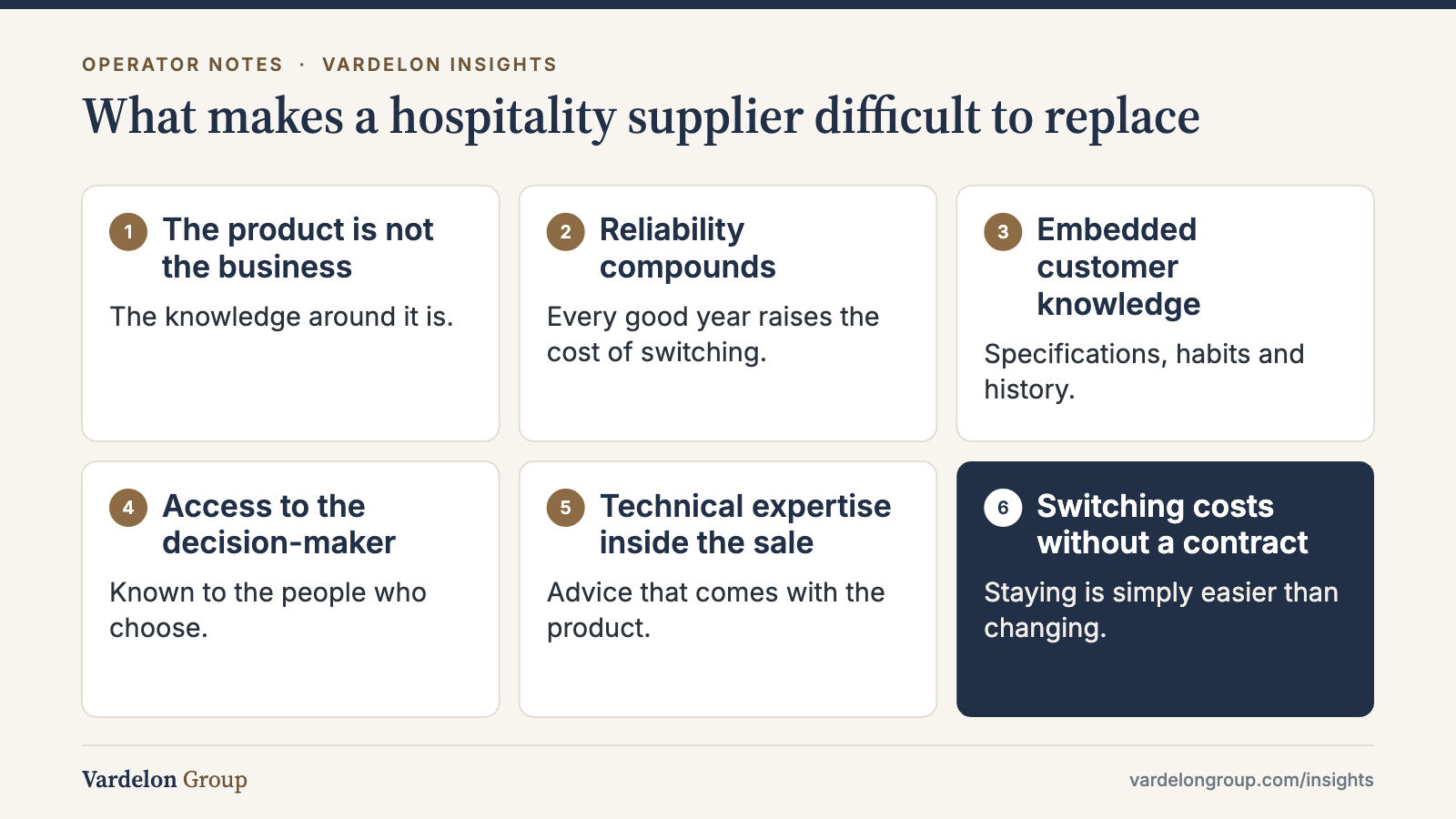
The product is not always the business
A distributor selling a commodity consumable to three hundred hotels may hold something considerably more valuable than the product itself: three hundred relationships, purchasing histories, delivery routes, and access to the people who make decisions.
The product can be sourced elsewhere. The relationship cannot.
Reliability compounds
Every time a supplier delivers what was promised, when it was promised, a small amount of credit accumulates. Every time something goes wrong and is resolved quickly, more accumulates.
After several years, this becomes an asset. It does not appear on a balance sheet, and it is invisible to a competitor reading a tender document, but it is the reason the incumbent keeps winning. A new supplier does not start at zero; it starts behind, because it has to prove something the incumbent has already proven.
Embedded customer knowledge
A supplier who has served a property for years knows things that were never written down.
Which floor has the storage constraint. Which specification the housekeeping manager rejected last time and why. When the property enters its peak period. Which product substitution is acceptable and which will generate a complaint. Who actually signs off, as opposed to who appears on the org chart.
Some of this can sit in a CRM. Most of it sits in people, and it transfers slowly if at all.
Access to the decision-maker
In hospitality, purchasing authority is often distributed in ways that are not obvious from outside. The general manager, the F&B director, the housekeeping manager, the technical manager and a group procurement function may all hold part of the decision.
Knowing who to call, and being able to call them, is a capability in itself. It takes years to build and can be lost in a single restructuring.
Technical expertise inside the sale
In several categories — chemicals and dosing, commercial kitchen, laundry equipment, technical systems — the supplier is also the person who specifies, installs, trains and repairs.
Here the distinction between product and service disappears entirely. The customer is not buying a machine; they are buying the certainty that the machine will work during a full house, and that someone competent will arrive if it does not.
Switching costs without a contract
None of this requires contractual lock-in. That is what makes it interesting.
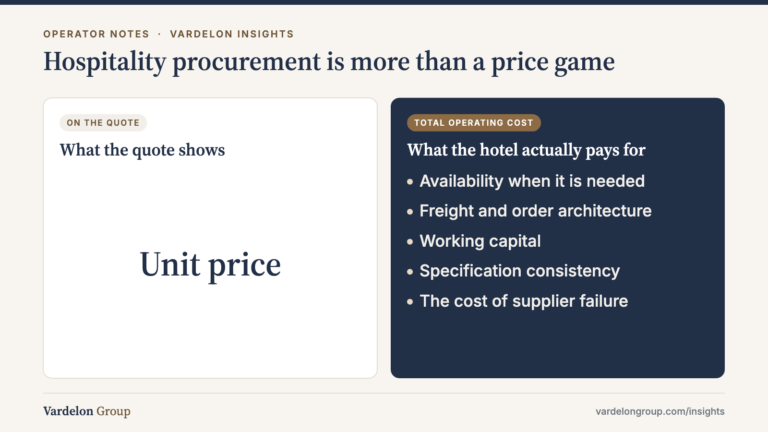
The switching cost is operational: retraining staff, requalifying specifications, absorbing the risk of an unfamiliar supplier during a period when failure is expensive, and rebuilding the informal knowledge that made the previous relationship work. A procurement director can calculate the saving. The operations team is the one that absorbs the cost.
Why this matters strategically
If you look at hospitality infrastructure as a collection of interchangeable product companies, the fragmentation looks like an inefficiency waiting to be corrected.
If you look at it as a collection of accumulated customer relationships, technical knowledge and service capability, the picture changes. The fragmentation is partly a map of where value has been built locally over long periods.
That has a direct consequence for how any regional group should be built. The things that make a supplier difficult to replace are, almost by definition, the things that should not be centralised. What can usefully be shared sits behind them: procurement, systems, product access, capital, specialist management.
Or, put more simply: the reason a company is worth partnering with is usually the reason you should not change it.