Why Regional Scale Matters in Hospitality Supply
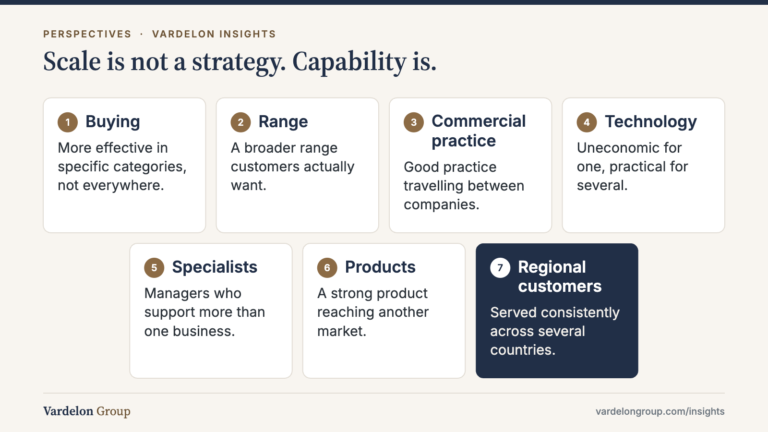
Scale is not a strategy. It is an outcome. The useful question is which specific capabilities become better when they are shared.
Consolidation arguments in fragmented markets tend to be made at the level of the market: this sector has no dominant player, therefore there is an opportunity to build one. That reasoning is too coarse to act on.
A more useful approach is to go capability by capability and ask, honestly, whether each one improves when it is shared across several businesses. Some clearly do. Several clearly do not.
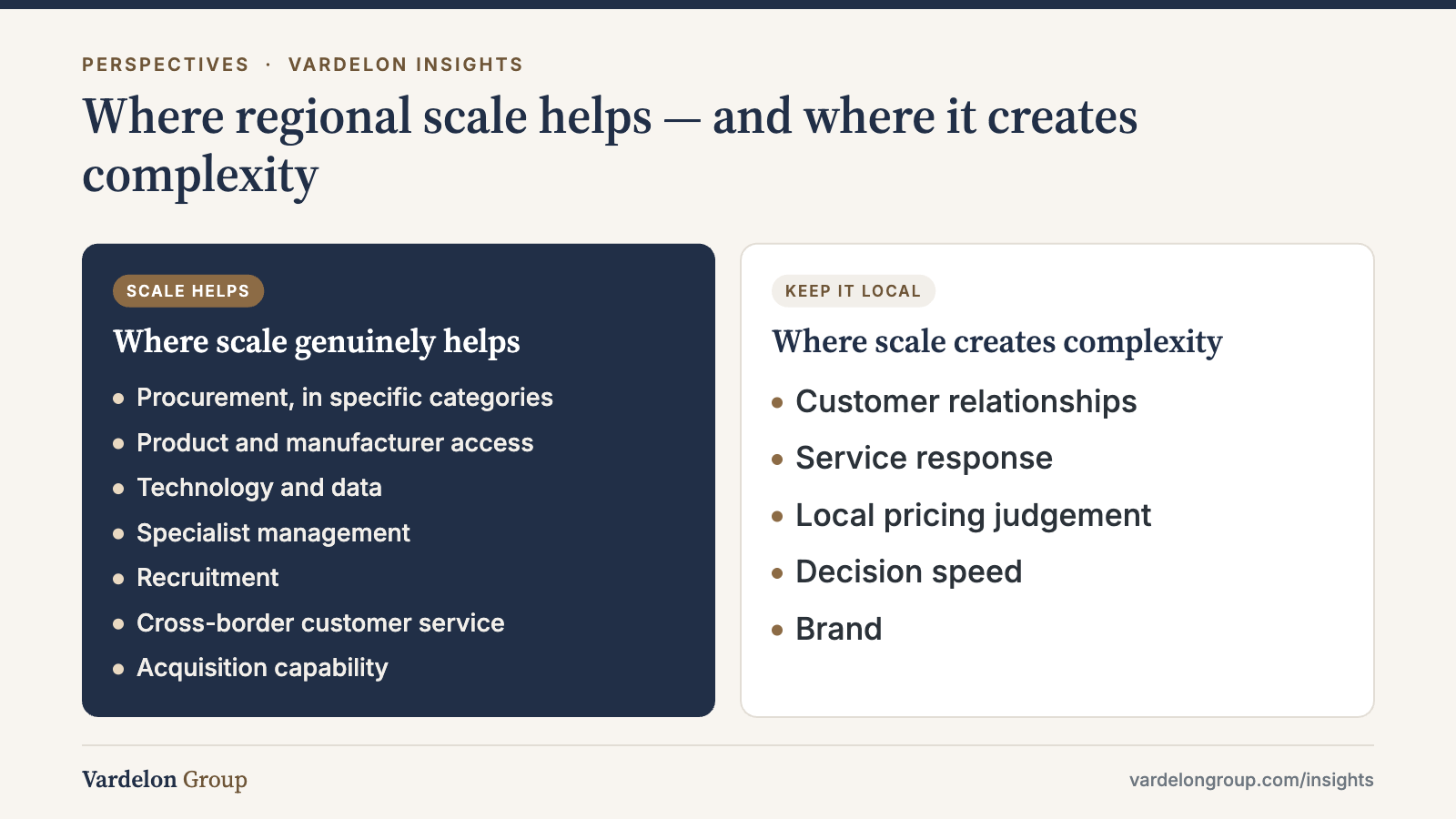
Where regional scale genuinely helps
Procurement, in specific categories
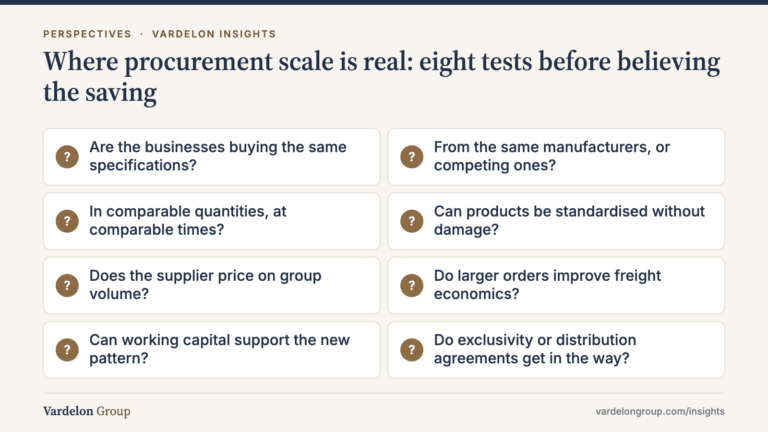
Combined volume improves terms where products, specifications, manufacturers and order patterns actually overlap. Where they do not, adding volume changes very little. This is why procurement synergy should be evidenced supplier by supplier rather than assumed as a percentage.
Product and manufacturer access
A distributor in one market may hold a product line or manufacturer relationship that has no route into a neighbouring market. An existing, trusted local organisation is a far cheaper route than building distribution from nothing.
Technology and data
Business intelligence, integrated ordering, stock visibility, cybersecurity and reporting infrastructure carry a fixed cost that is disproportionate for one mid-sized company and entirely reasonable across several.
Specialist management
A capable procurement specialist, a strong finance leader or a genuinely experienced commercial director may be unaffordable for one company and obviously worth it across five.
Recruitment
A group can attract people that individual companies cannot, partly through career path and partly through simple visibility.
Cross-border customer service
Hotel operators working across several markets increasingly value suppliers who can coordinate specification, service standards and commercial terms across those markets.
Acquisition capability
Sourcing, diligence, financing and integration are skills an operating business needs occasionally and therefore cannot justify maintaining. A group uses them continuously.
Where scale creates complexity instead
Not everything improves with size, and pretending otherwise is how good acquisitions become disappointing ones.
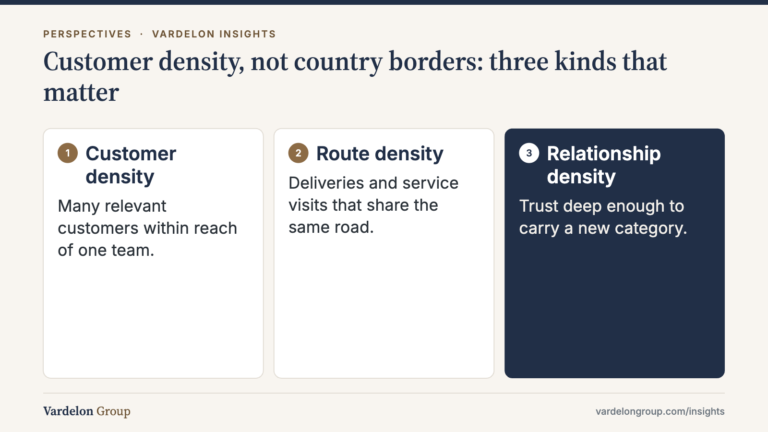
- Customer relationships. These do not scale. They are held by individuals and degrade when distance is introduced.
- Service response. An engineer two countries away is not a cheaper version of an engineer in the same city.
- Local pricing judgement. Centralised pricing tends to be slower and worse in markets that behave differently from each other.
- Decision speed. Every additional approval layer costs something, and in service businesses it usually costs a customer.
- Brand. Replacing a name that has carried a reputation for thirty years rarely creates more value than it destroys.
The test we apply
Before centralising anything, we think three conditions should hold. The capability should be expensive to build alone. Its quality should improve with broader scale. And distance from the customer should not materially reduce its effectiveness.
Technology passes that test easily. Customer relationships fail it immediately. Most things sit somewhere in between and deserve to be argued individually rather than decided by policy.
Almost anything can be centralised. The question is whether centralising it makes the underlying business better.
Why this matters for how a group is built
If you accept that only some capabilities improve with scale, the design of the group follows. The local business stays the customer-facing engine. The regional layer exists to make that engine more capable — not to replace it, and not to supervise it.
That is a slower model than a conventional roll-up. It is also, in our view, the one more likely to still be working in a decade. We describe it in full under our approach.