Service Intensity: The Hidden Variable in B2B
Two distributors with the same revenue, the same customers and the same margin can be completely different businesses. The variable that separates them is service intensity.
By service intensity we mean the amount of human, technical and operational work required to keep a euro of revenue in place. It is rarely measured, and it explains more about a business than almost any figure in the accounts.
The spectrum
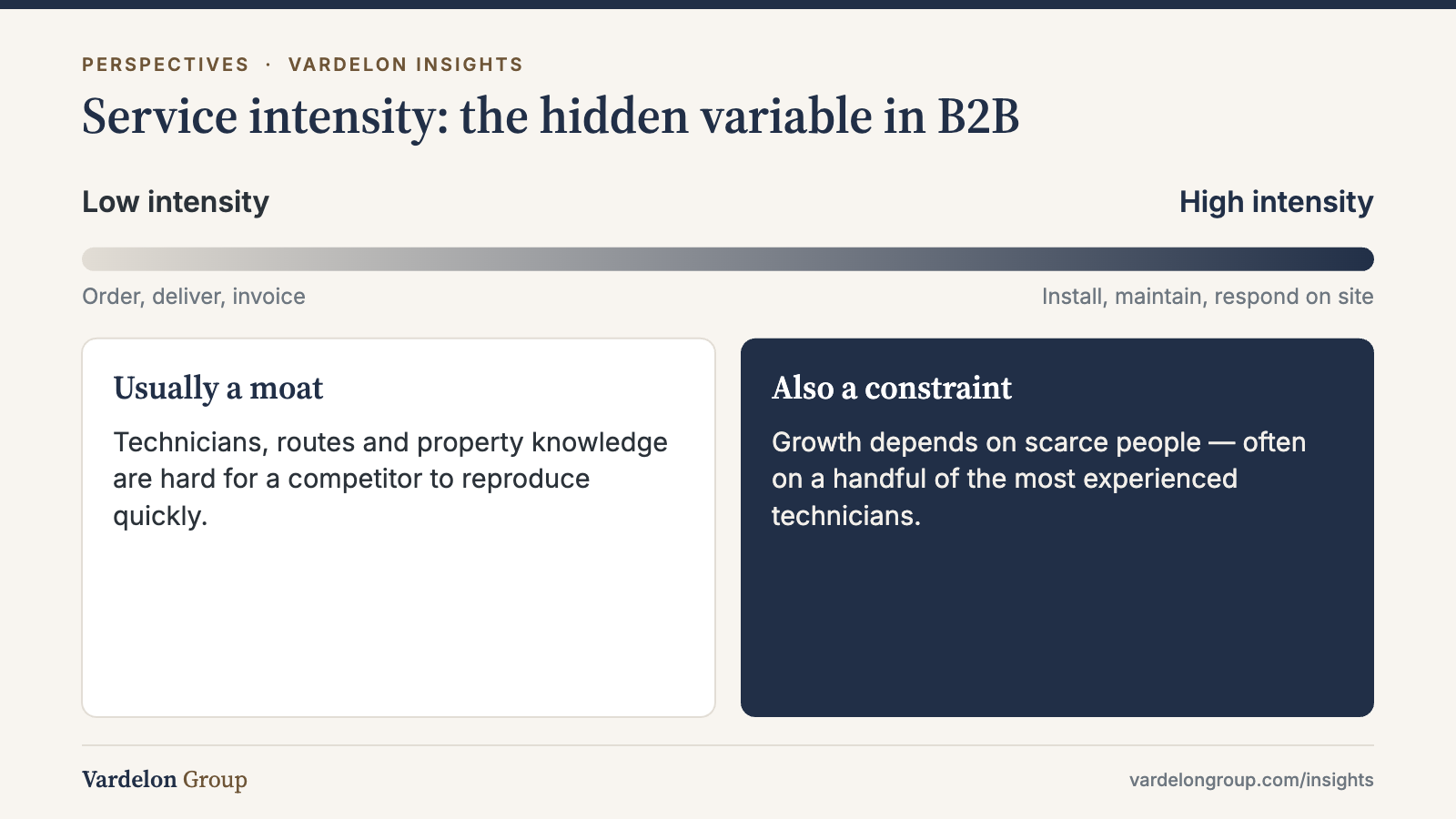
At the low end sits a product delivered to a loading bay against a standing order. Little needs to happen for the revenue to recur. The customer relationship is real but thin.
At the high end sits a commercial kitchen installation, a dosing system that requires calibration, or a laundry service where the supplier operates inside the customer’s daily rhythm. Here the revenue depends on people, response times and accumulated knowledge of the property.
Most hospitality infrastructure businesses sit somewhere between, and where they sit determines almost everything about how they should be owned and run.
Why high intensity is usually a moat
Service-intensive relationships are harder to displace. A competitor offering a lower price must also credibly offer the engineer, the response time and the property knowledge. That is expensive to assemble and slow to prove.
It also changes the nature of switching cost. As we set out in what makes a supplier difficult to replace, the barrier is operational rather than contractual — and the more service sits inside the relationship, the higher it climbs.
Why high intensity is also a constraint
The same characteristic caps how fast the business can grow. Every new customer requires capacity: a trained technician, a service slot, a vehicle. Growth is bounded by hiring rather than by demand.
It also makes geography sticky. A service-intensive supplier can serve a radius, not a market. Expanding means building capability in a new place, not shipping further.
What this means for a group
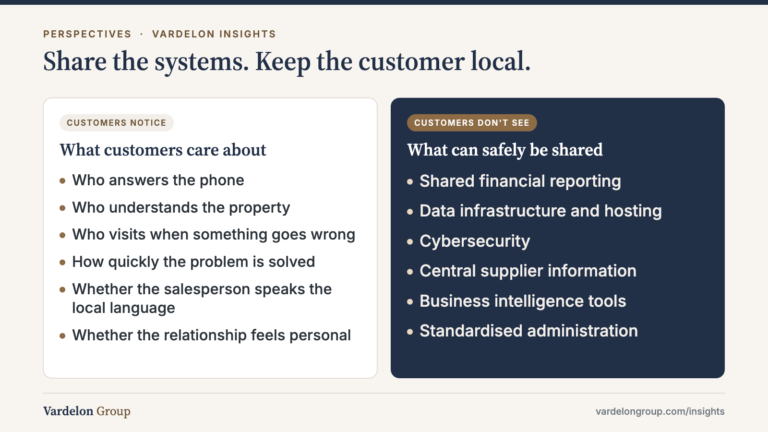
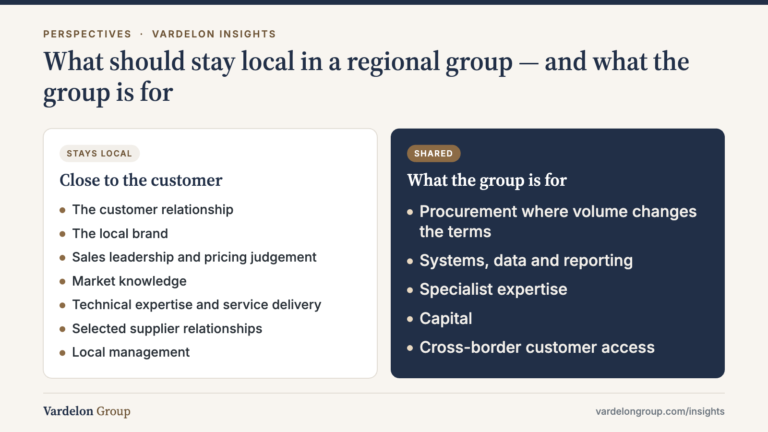
Service intensity is the single most useful test for deciding what should stay local. Anything the customer experiences as service belongs close to them. Anything behind it may not.
It also means that mixing high- and low-intensity businesses in one group requires care. They have different cost structures, different growth constraints and different management rhythms. Running them on one template usually damages the more service-intensive one.
How to read it in a specific business
- What share of staff are customer-facing or technical, rather than administrative?
- How often does someone from the company physically visit a typical customer in a year?
- What proportion of revenue depends on a scheduled service obligation?
- How long would it take a competent competitor to reproduce the service capability?
- If the three most experienced technicians left, what would happen?
That last question is uncomfortable and informative. In a high-intensity business, it usually reveals that a significant part of the value is held by a small number of people — which is a risk, and also the reason the business is defensible.
The practical conclusion
Revenue tells you the size of a business. Service intensity tells you what kind of business it is, how quickly it can grow, what protects it, and which parts of it must never be moved further from the customer.