Mapping the Hidden Layer: 1,000 Hospitality Infrastructure Companies in CEE
We have spent the past months mapping the companies behind hotels in Central and Eastern Europe, one business at a time. This is a first look at what that map shows, in aggregate.
Most writing about hospitality in this region is about hotels. Very little is about the businesses that keep them running: the laundries, textile makers, hygiene specialists, kitchen and furniture contractors, and the distributors who supply everything from amenities to trolleys. That layer is hard to see from the outside because it is made of hundreds of mid-sized private companies, most of which never appear in a transaction database.
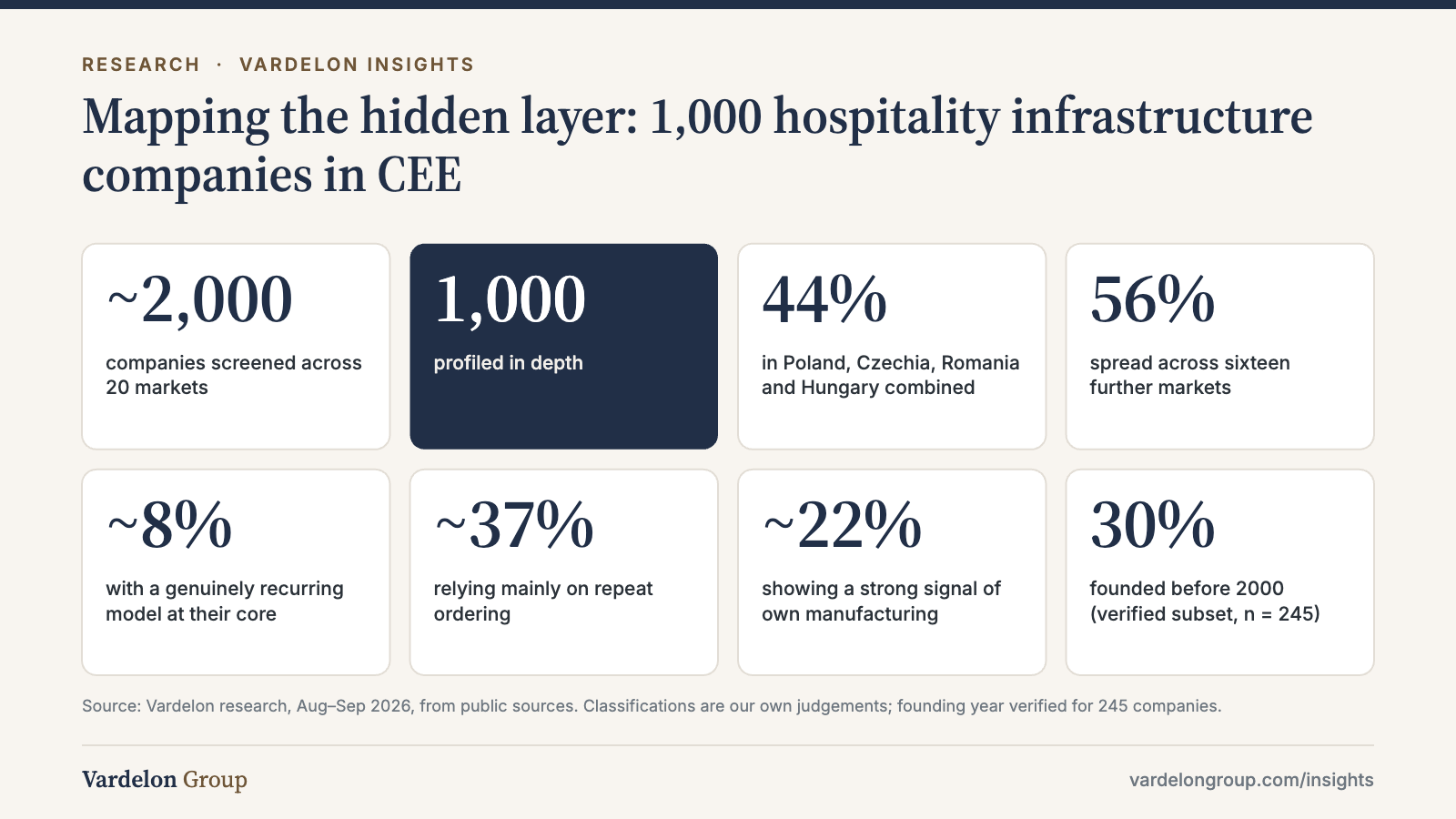
So we built our own view of it. We screened around 2,000 companies across 20 markets and profiled the 1,000 most relevant in depth, using company websites, national business registers, published financial filings, trade directories and industry references. The figures below describe that profiled set of 1,000 companies. We do not name individual businesses.
1. No single market holds the layer together
Even the largest markets account for a modest share. Poland, the Czech Republic, Romania and Hungary together hold 44% of the companies we profiled. The remaining 56% are spread across sixteen further markets, most of them small. For a hotel group operating in five or six of these countries, that is five or six largely separate supplier landscapes.
n = 1,000. Further markets: Albania, Kosovo, North Macedonia, Latvia, Estonia, Montenegro, Moldova, Lithuania, Bosnia & Herzegovina, Ukraine.
The distribution partly reflects the size of each hotel market and partly how visible companies are in public sources. It is not a count of every supplier in the region; it is the set we judged relevant enough to profile.
2. Six categories, one customer
By industry code these companies belong to very different sectors. From the customer’s side they look far more alike: they sell into the same properties, often to the same people. That is why we group them as hospitality infrastructure rather than by classification.
n = 1,000. Categories are our own grouping of each company’s primary activity.
3. Recurring revenue is rarer than people assume
This is the finding we found most useful. We classified each company by how its revenue recurs: a core recurring model (rental, service contracts, managed consumable programmes), repeat ordering without a formal commitment, or transactional and project-based sales.
Only around 8% of the profiled companies have a genuinely recurring model at their core. Around 37% rely on repeat ordering, and just over half sell mainly order by order or project by project.
n = 1,000. Classification based on each company’s public description of its offer and, where available, its financial filings.
The recurring economics are concentrated. Laundry and linen services account for almost two-thirds of the core recurring models we found; rental and service contracts are built into how that category works. Hygiene is almost entirely repeat business, anchored by dispensing equipment and technical service. At the other end, FF&E and most supply and distribution businesses sell transaction by transaction.
That does not make the transactional businesses weaker. In supply and distribution, repeat business is usually held together by reliability and account knowledge rather than by contract, a point we made in Reliability Is the Product in Hotel Supply. But it does mean recurrence in this layer is mostly designed rather than inherited. Standing orders, par-level management, dispensing programmes and service agreements are choices a supplier can make, and relatively few have made them.
4. The layer is more technical than it looks
Hospitality suppliers are often described as traders. The profiles suggest otherwise. Around 22% of the companies show a strong signal of their own manufacturing, and roughly two in five show installation, technical service or customisation capability. In kitchens, laundry equipment, hygiene systems and contract furniture, what the customer is buying is frequently the ability to specify, install and maintain, not just the product.
That matters for anyone thinking about scale. Technical capability is slow to build and does not travel automatically across a border, which is one reason local champions often stay local.
5. A generation of companies approaching transition
Founding dates are the least complete field in our data: we could verify them for 245 of the 1,000 companies. Within that subset, 30% were founded before 2000 and 57% before 2010.
n = 245. Founding year indicates the age of the company, not the age of its owner.
A founding year is only an indirect signal. It says nothing certain about the age of the owner or their plans. But a large group of established, founder-built companies with twenty or thirty years of history is exactly the population in which succession becomes a practical question rather than a distant one.
What we take from it
- The supplier layer is fragmented by geography as much as by category. That is the structural fact behind almost everything else we write about.
- Recurring revenue exists, but it is concentrated in a few categories. Elsewhere, relationships do the work that contracts do in other industries.
- Many of these businesses have real technical depth. That capability is valuable and hard to replicate, and it rarely crosses borders on its own.
- A meaningful share of the layer is old enough for ownership to become a question within the next decade.
About the data
The dataset was compiled by Vardelon between August and September 2026 from public sources: company websites, national business and financial registers, trade directories and industry references. Companies were included where hospitality is a material part of their customer base. Classifications of category, revenue model and capability are our own judgements based on those sources, and some fields are incomplete, as noted under each chart. Percentages are rounded. We will update this analysis as the profiles are extended and verified.
If you own or advise a business in this layer, we are always interested in a conversation →