Why Acquisition Count Is a Bad KPI
Transaction count is visible, easy to report and almost useless as a measure of whether a buy-and-build strategy is working.
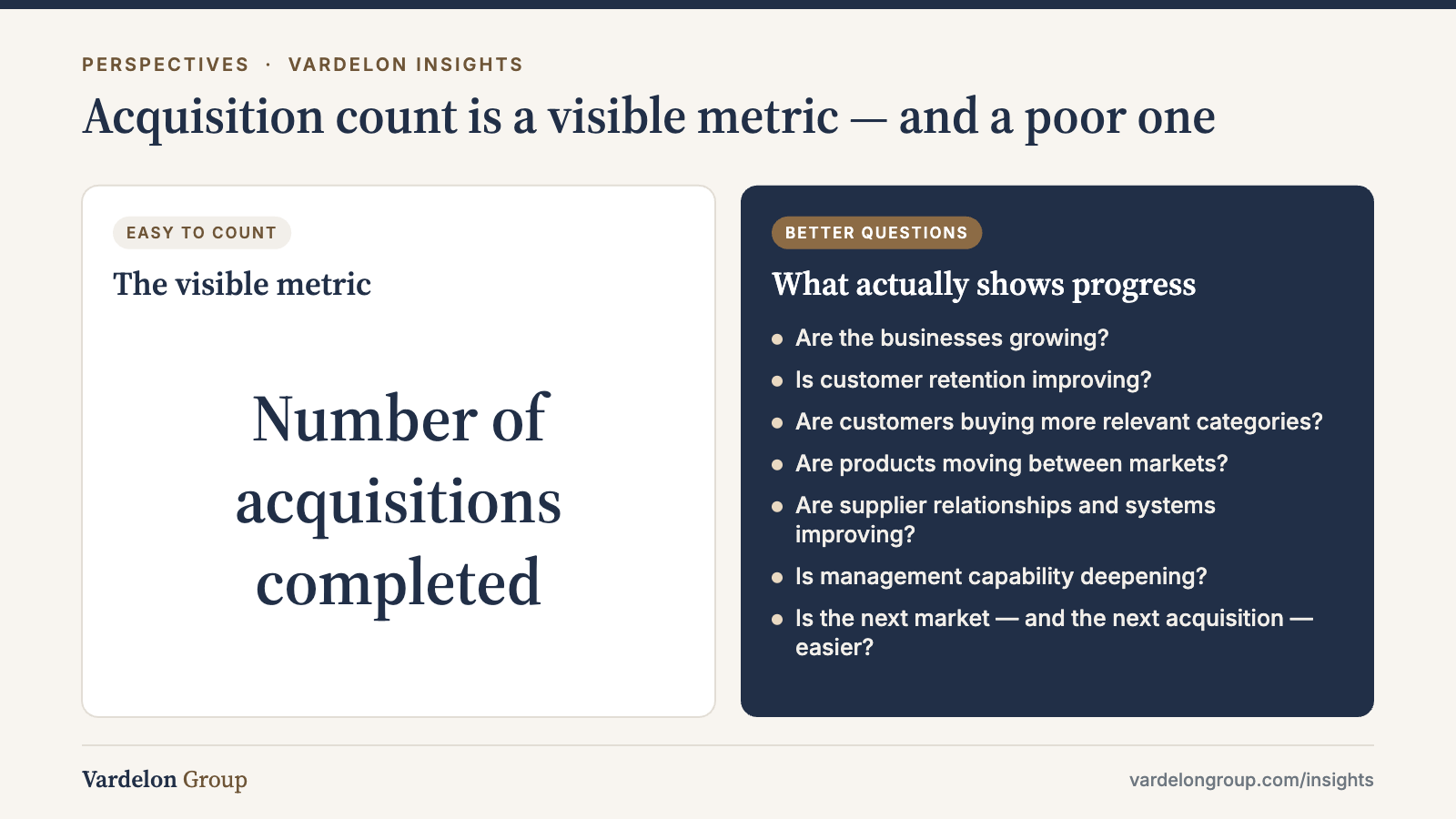
Five acquisitions sounds more impressive than two. Twenty sounds more impressive than five. This is why the number gets used: it is unambiguous, it is comparable, and it demonstrates activity.
It also tells you nothing about whether the underlying businesses are better than they were.
Why the metric survives
Because company quality is difficult to measure and transaction count is not. Given a choice between a precise measure of the wrong thing and an imprecise measure of the right thing, organisations reliably choose the first.
An organisation can complete a large number of transactions and still fail to build a platform. It will simply have assembled an expensive collection of logos.
A better set of questions
- Are the underlying businesses growing?
- Is customer retention improving?
- Are customers buying more relevant categories?
- Are products moving between markets?
- Are supplier relationships improving?
- Are systems getting better rather than merely more numerous?
- Is management capability deepening?
- Can the group recruit people the individual companies could not attract?
- Is entering the next market easier than the last one was?
- Does the next acquisition become more valuable because of infrastructure already built?
These are harder to report and much closer to the thing that matters.
Event versus capability
An acquisition is an event. A platform is a capability system. Confusing the two is how a strategy that looks successful for three years becomes difficult to explain in the fourth.
The distinction also changes pacing. If capability is the objective, there is no advantage in acquiring faster than the organisation can absorb — and considerable risk in doing so.
An acquisition is an event. A platform is a capability system.