Reliability Is the Product in Hotel Supply
A hotel does not buy a product. It buys the confidence that the product will be there, and that someone competent will answer when it is not.
Ask a procurement director what they buy and you get a specification. Ask a general manager what they need and you get something different: for the linen to arrive before the group check-in, for the dishwasher to be fixed today rather than Thursday, and for nobody to have to think about either.
That gap between what is specified and what is needed is where most of the durable value in hospitality supply sits.
The asymmetry of failure
Procurement decisions are usually evaluated on the upside: how much can be saved. The downside is rarely quantified, because it is intermittent and lands on a different department.
When a supplier fails during a full house, the hotel does not calmly wait. It sources locally at whatever price is available, absorbs the operational disruption, deals with the guest consequences, and remembers exactly who caused it. The cost of that single event routinely exceeds a year of the saving that produced it.
Which means reliability is not a soft attribute. It is an economic one that happens to be difficult to put in a tender document.
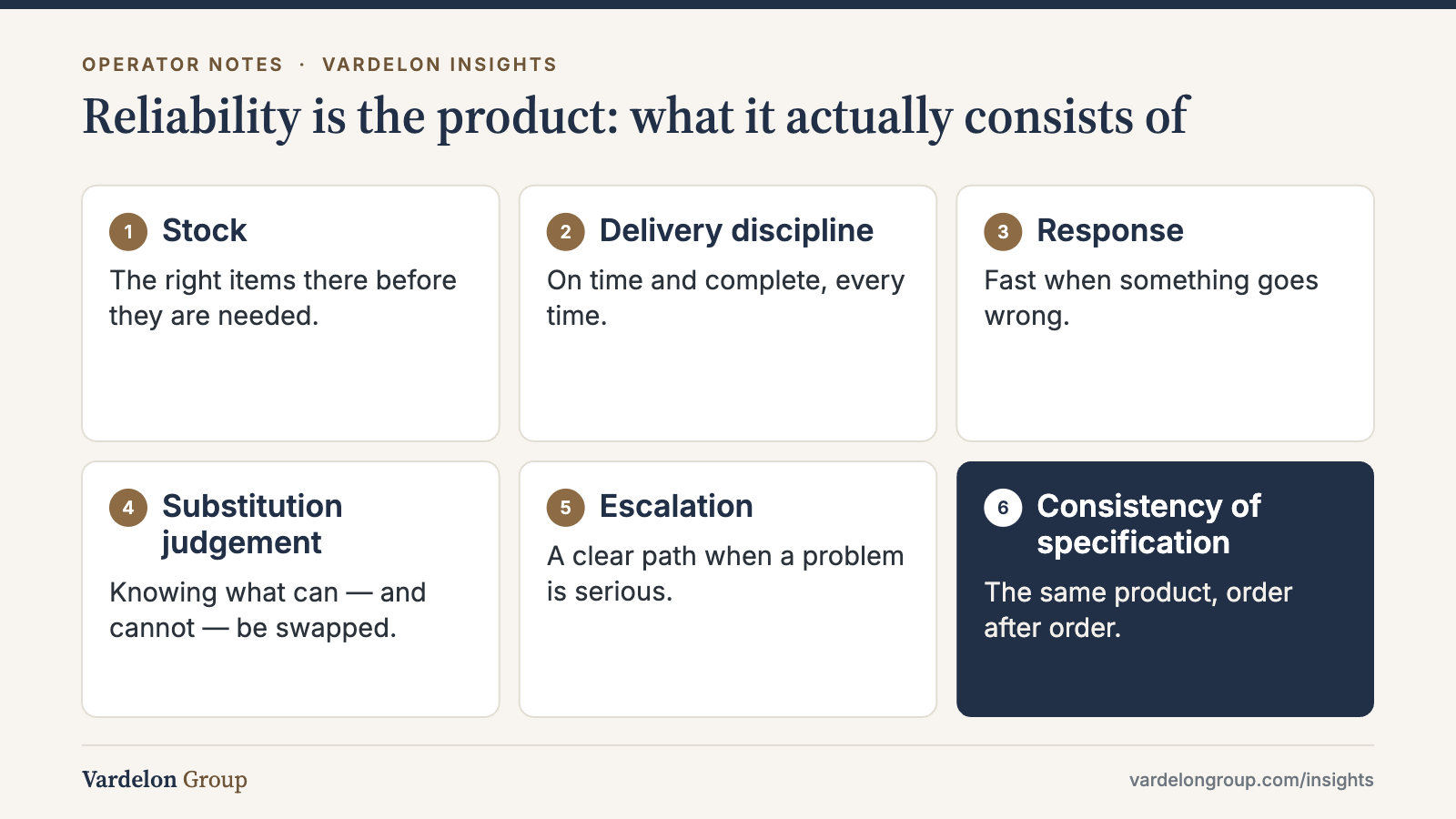
What reliability actually consists of
- Stock. Holding inventory is expensive and it is a service. A supplier who never runs out is financing that promise.
- Delivery discipline. Not average delivery time — variance. A supplier who is usually fast and occasionally very late is worse than one who is consistently adequate.
- Response. How long between a problem being reported and a competent person addressing it.
- Substitution judgement. Knowing which product can be swapped without a complaint and which cannot.
- Escalation. Whether there is a person who can make a decision, and whether they answer the phone.
- Consistency of specification. The same product, actually the same, order after order.
Why this compounds
Every time a supplier delivers what was promised, a small amount of credit accumulates. Every time something goes wrong and is resolved quickly, more accumulates. After several years this becomes an asset that does not appear anywhere in the accounts.
It is also why incumbents are so difficult to displace in this industry. A new supplier does not start from zero; it starts behind, because it must prove something the incumbent has already proven repeatedly.
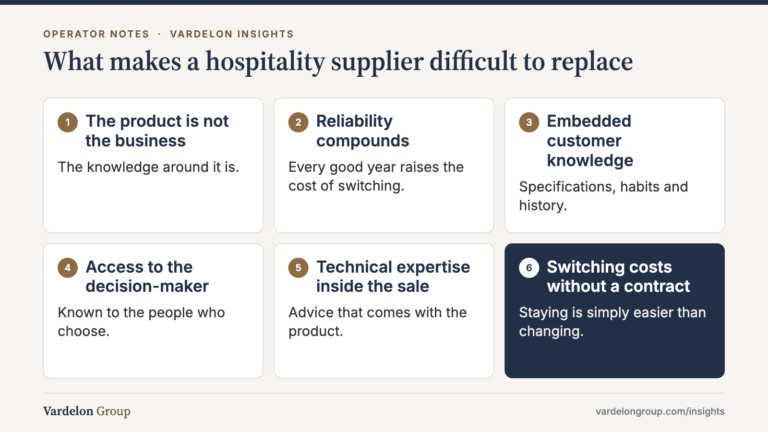
We wrote about the related mechanics in what makes a hospitality supplier difficult to replace.
What this means for suppliers
If reliability is the product, then the operational investments that look like cost are frequently the ones that protect margin: stock depth in the categories where failure is expensive, a service capability that can genuinely respond, and enough people that one person’s holiday is not a risk to a customer relationship.
It also suggests where not to compete. A supplier that has built genuine operational reliability and then chooses to compete primarily on price is discarding its own advantage.
What this means for buyers
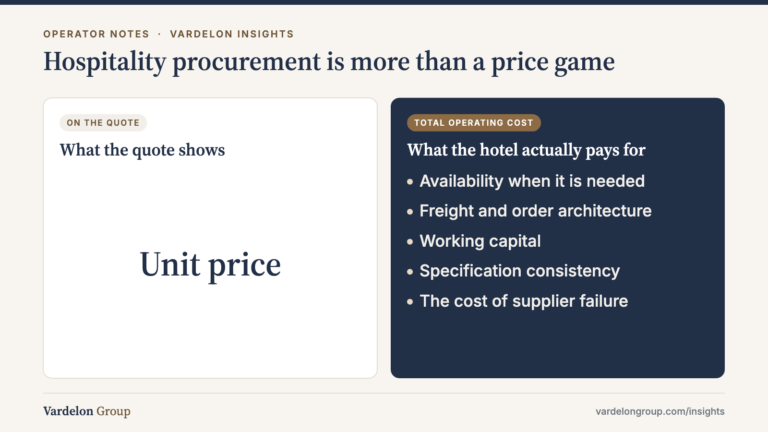
The practical version is simple: compare total operating cost rather than unit price, and treat availability, response time and specification consistency as line items rather than as goodwill.
A supplier who is three percent more expensive and never fails is not more expensive.
Customers who stay with a supplier that costs slightly more are not being irrational. They are pricing risk.
And for anyone building a group
This is one of the clearest arguments for keeping service delivery local. Response time is not something that improves when it is centralised, and reliability built over fifteen years in one market is not transferable by reorganisation.
Scale should be used to make local reliability easier to deliver — better stock information, deeper product access, more capable people — not to move it further from the customer. That principle sits at the centre of our approach.