Pricing Discipline in B2B Distribution
Margin in a distribution business is almost never lost in a single bad decision. It leaks, quietly, over years.
Ask a distributor where its margin went and you usually get a market answer: competition, price pressure, a customer that pushed hard. Look at the transaction data and you generally find something less dramatic and more fixable.
The four common leaks
Discounts that were never reviewed. A concession granted for a specific reason in a specific year becomes permanent because nobody revisits it. Multiply by a decade and a customer list.
Prices that never moved. Cost increases pass through on new business and not on the existing base, because raising a price with a long-standing customer is an uncomfortable conversation that no one is required to have.
Inconsistency between comparable customers. Two properties of similar size and volume paying materially different prices, for reasons nobody can now reconstruct. This is a commercial risk as well as a margin one.
Freight and small orders absorbed silently. Delivery cost does not scale with order value, so a customer ordering frequently in small quantities can be unprofitable at a headline margin that looks fine.
Why it happens in good companies
Because every individual decision was defensible. The discount kept a customer. The unchanged price avoided a difficult call during a bad quarter. The extra delivery kept a promise.
Pricing discipline is not about being tougher. It is about making sure that decisions of this kind are visible, deliberate and periodically revisited rather than accumulating unnoticed.
What discipline actually looks like
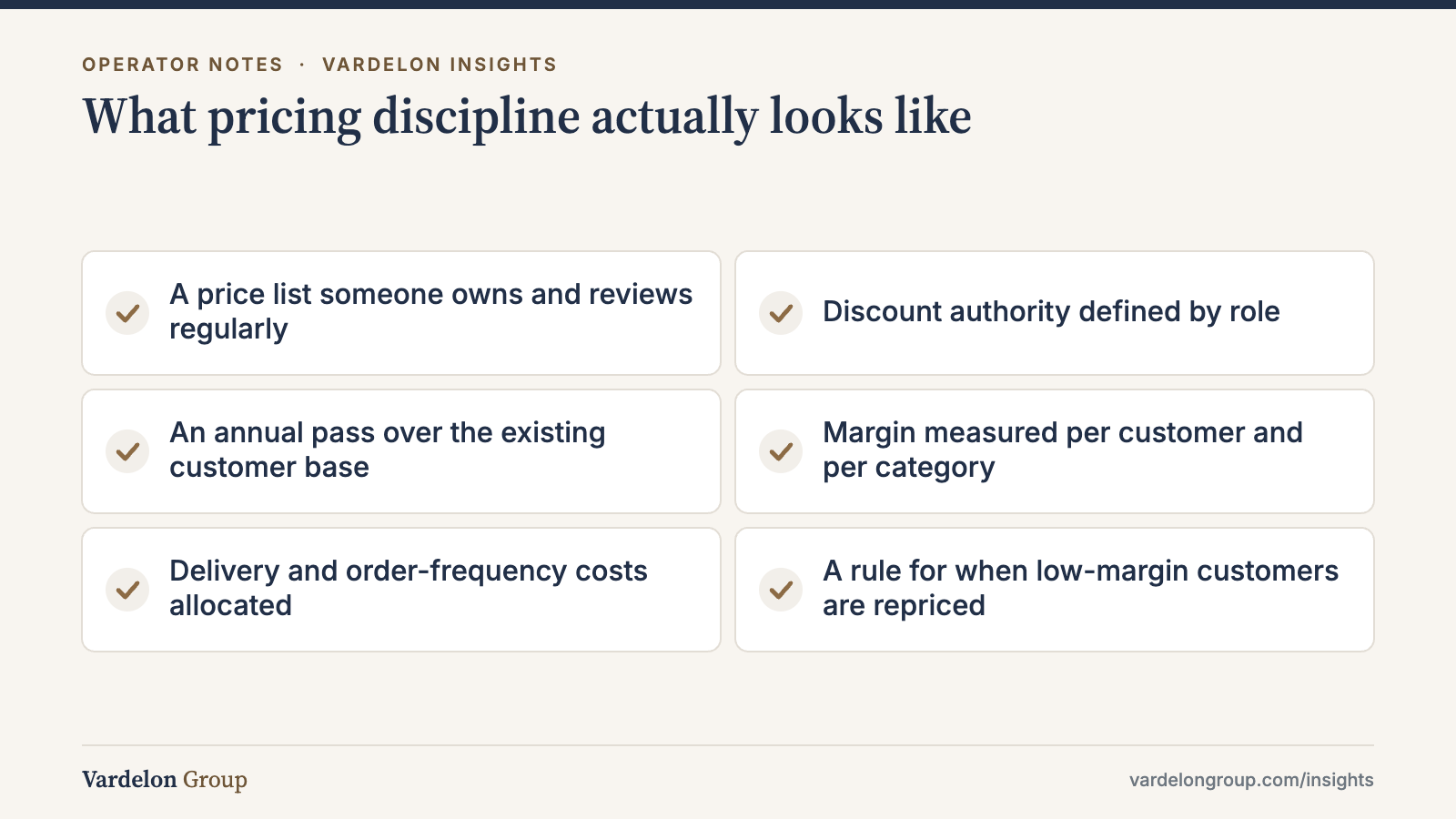
- A price list that someone owns and reviews on a schedule
- Discount authority that is defined by role and recorded
- An annual pass over the existing base, not just new business
- Margin measured per customer and per category, not only in aggregate
- Delivery and order-frequency cost allocated to the accounts that generate it
- A rule for when a low-margin customer is repriced or released
The uncomfortable part
Applying this to a founder-led business almost always surfaces a handful of long-standing customers who are, on a fully allocated basis, unprofitable. Frequently they are the ones with the deepest personal relationships.
The answer is rarely to drop them. It is usually to understand why the economics look that way — order pattern, mix, delivery frequency — and to change one of those rather than the relationship.
Why it matters more at scale
In a single business, pricing knowledge can live in one person’s judgement and still work. Across several companies it cannot. Comparable information is the only way to see whether a price in one market is sensible relative to another.
That is an argument for shared systems, not for central pricing. Local judgement about a customer is usually better than a spreadsheet. But it should be informed judgement. More on that distinction →