What Makes a B2B Business Worth Owning
Interesting markets do not automatically contain good companies. The two questions are separate, and the second one matters more.
It is easy to build a convincing case for a sector. Market size, growth rate, fragmentation, structural tailwinds — the arguments are usually available and often true. None of them tell you whether any individual company in that sector is worth owning.
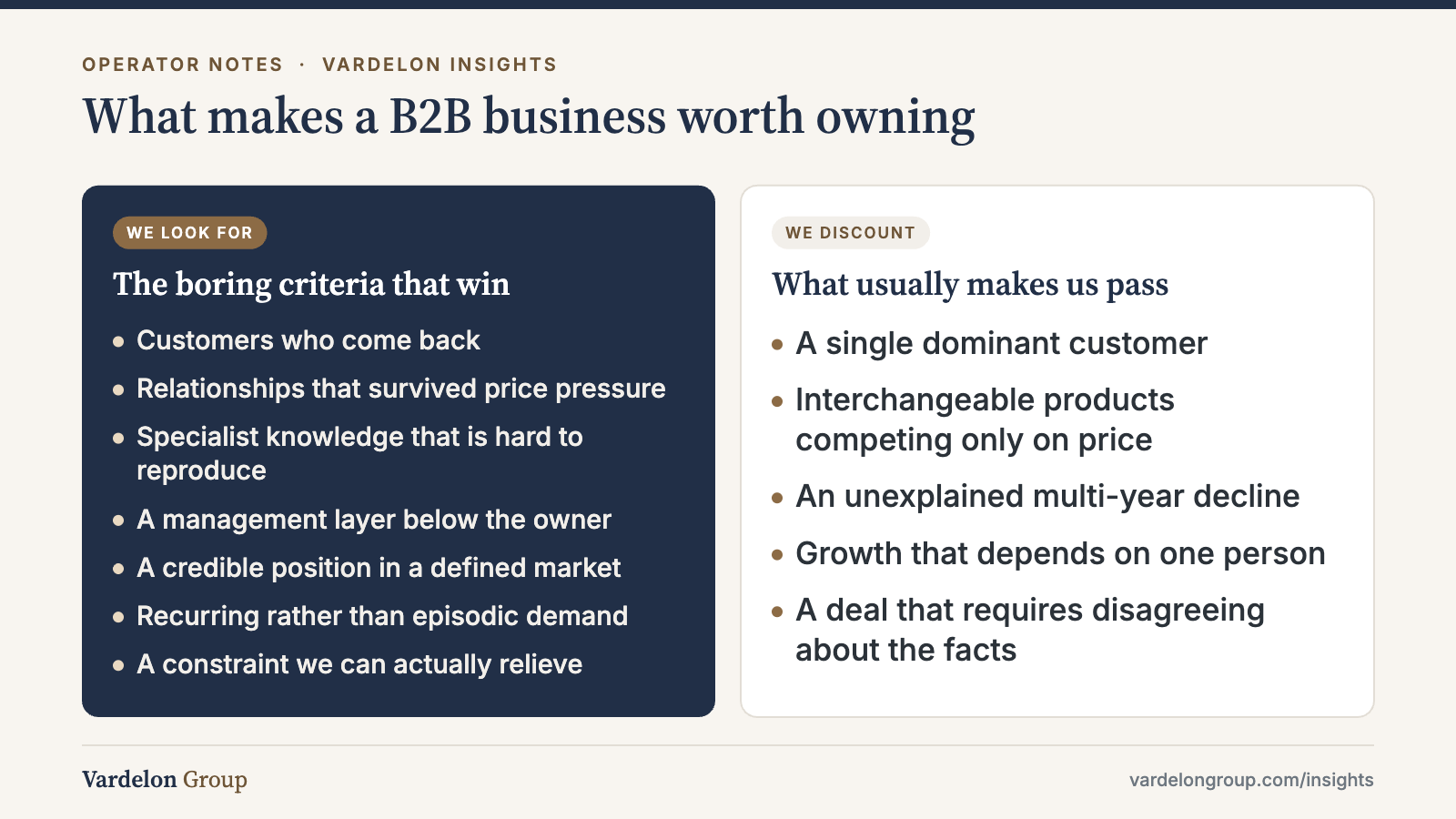
The characteristics we look for are unglamorous and fairly consistent.
Customers who come back
The single most informative number in a B2B business is not revenue. It is what share of this year’s revenue came from customers who were also there last year.
Repeat purchasing is evidence that something worked. It cannot be faked in a data room, and it is very difficult to rebuild once lost.
Relationships that have survived price pressure
Every supplier has been undercut at some point. What matters is what happened next.
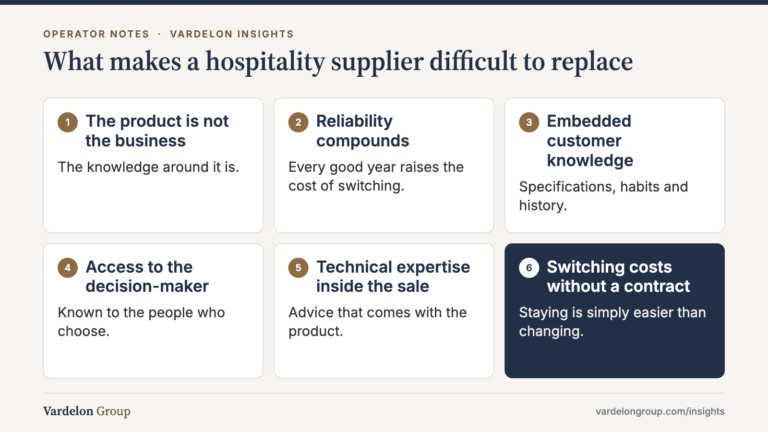
A customer who stayed after receiving a cheaper quote is telling you something specific: that the relationship contains value beyond the unit price. That is the most durable competitive position available in distribution, and it is invisible in a product catalogue.
Specialist knowledge that is hard to reproduce
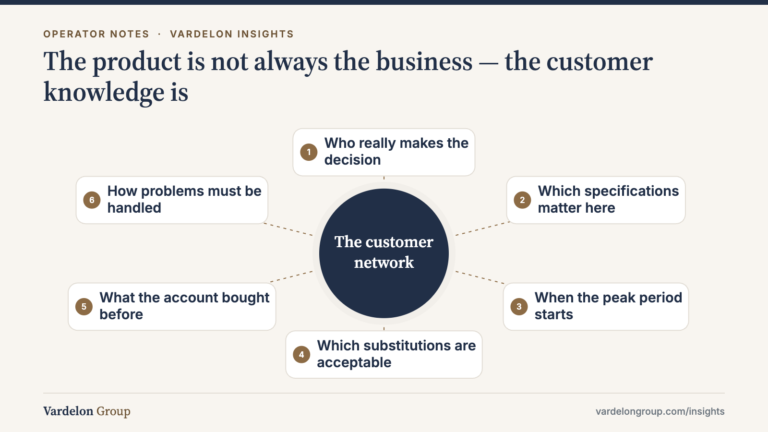
Knowing which specification actually performs in a commercial laundry, which dosing configuration reduces callouts, or which product will fail a particular property’s water conditions — this knowledge takes years to accumulate and is not written down anywhere.
A competitor can copy a price list overnight. They cannot copy fifteen years of knowing what goes wrong.
A management layer below the owner
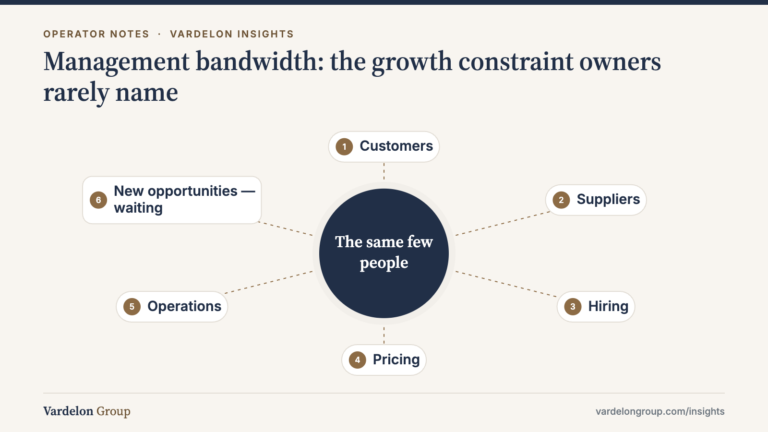
This is where many otherwise excellent businesses are weakest. If the founder holds the top customer relationships, sets pricing, negotiates with suppliers and approves credit, the company is more fragile than its numbers suggest.
The presence of a capable second layer is one of the strongest indicators that a business will survive a change of ownership intact. Its absence is not disqualifying, but it changes what needs to happen and how quickly.
A credible position in a defined market
We would rather see a company that matters in a clearly bounded market than one with a marginal share of a large one. Being the supplier that hotels in a region actually call is a stronger position than being the eleventh option nationally.
Recurring rather than episodic demand
Consumables, service contracts and replacement cycles produce a base that can be planned around. Project revenue can be excellent and can also disappear for a year for reasons nobody controls. Both can work; they should not be valued identically.
A constraint we can actually relieve
This one is easy to miss. A company doing everything it could possibly do, perfectly, is a fine business and a less interesting partner.
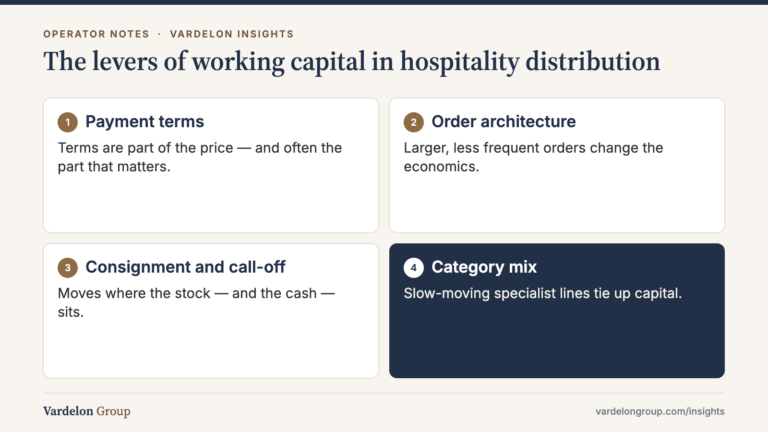
What we look for is a good company held back by something specific: succession, management bandwidth, product breadth, systems, geography or capital. Those are constraints a broader group can address. A company with no constraint has no reason to want one.
What we have learned to discount
- A single dominant customer. Concentration converts a good business into a negotiation.
- Genuinely interchangeable products with no service layer. Where price is the only lever, margin has one direction.
- An unexplained multi-year decline. If nobody in the company can account for it, diligence rarely will either.
- Growth that depends on one person continuing to work at an unsustainable pace.
- Any situation where buyer and seller would need to disagree about the facts to reach a deal.
Why the boring criteria win
None of this is a screening formula, and we do not think it should be. But the pattern holds: the businesses that survive ownership changes well tend to be the ones where the value sat in relationships, knowledge and repeat demand rather than in a moment of market timing.
That is also why our starting assumption after an investment is continuity rather than restructuring. What made the company worth partnering with is usually the thing most easily broken. More on that under our approach.