Why Local Champions Often Stay Local
Companies that dominate their home market often stop precisely where the map says they should keep going. The reason is rarely a lack of ambition.
A local champion is a recognisable type: a company that understands its market unusually well, whose customers know it, whose suppliers trust it, and whose management can solve problems quickly because they have seen them before. It may be invisible outside its industry and decisive within it.
Such a business frequently has an obvious next step. Its products would work next door. Its customers may already operate there. Manufacturers may be encouraging it. And still it does not go.
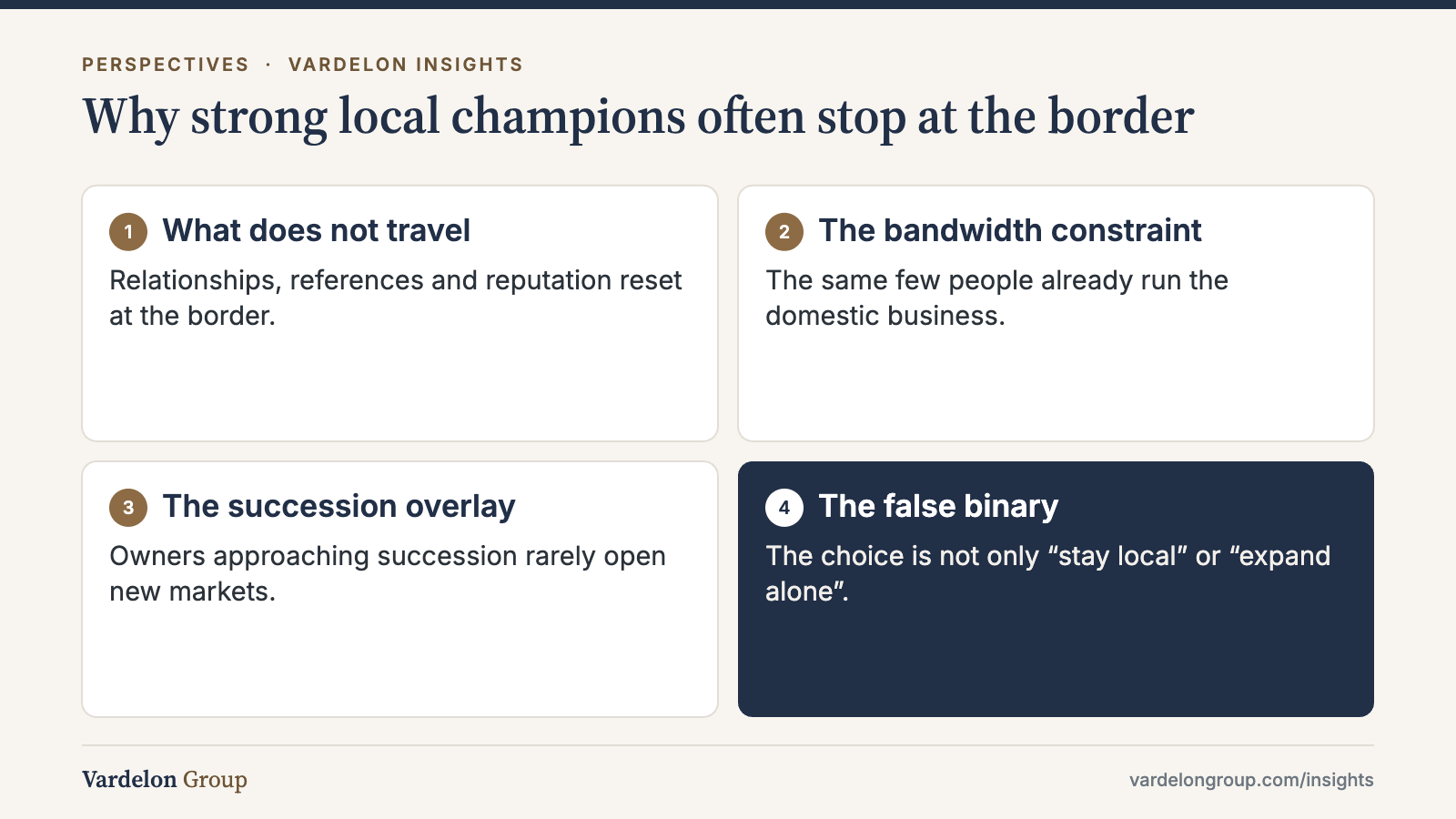
What does not travel
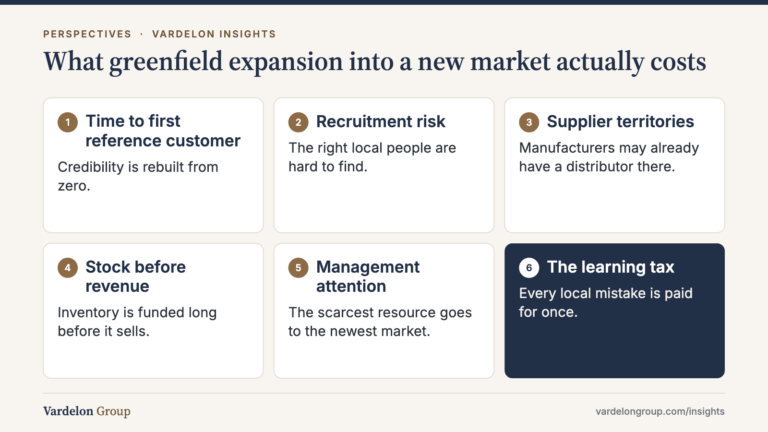
The advantages that make a company strong at home are mostly local by construction: reputation, references, competitor knowledge, experienced salespeople, supplier relationships, logistics routines and pricing intuition.
Cross a border and the product is unchanged while the business effectively restarts. That is why domestic capability is a poor predictor of international performance, and why confident companies are so often surprised.
The bandwidth constraint
The binding limit is usually attention rather than capital.
A successful B2B business already consumes its management team: major customers, supplier negotiations, hiring, pricing, cash flow, operational problems, technology. Adding a country means providing leadership before the country generates enough revenue to justify leadership. For a period, the core business gets less attention while the new market gets not quite enough.
Declining to accept that trade is often the correct decision, not a failure of nerve.
The succession overlay
There is a second constraint that arrives later. If the founder holds the most important relationships, expansion multiplies the dependency rather than reducing it. A company that is already fragile around one person becomes more so when it operates in three countries.
This is why expansion and succession are frequently the same conversation in disguise.
The false binary
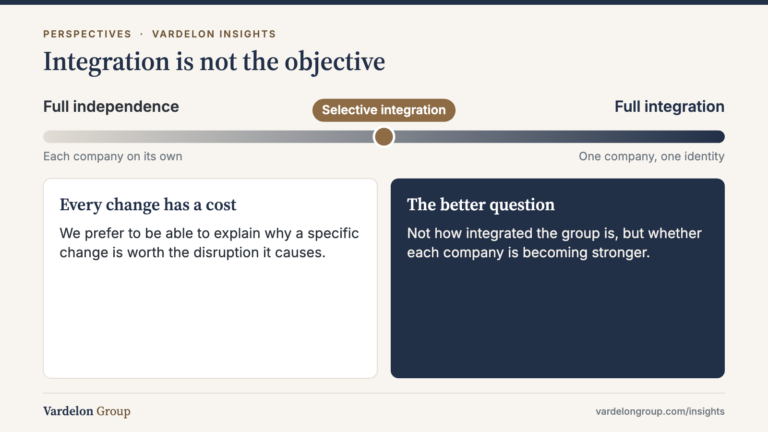
The choice is usually framed as: stay independent and local, or be absorbed into something larger and lose what you built.
We think there is a third option. A strong local business can keep the capabilities that make it locally effective while gaining access to the ones that are expensive to build alone — systems, product access, specialist management, capital, and a route into neighbouring markets that does not start from zero.
The barrier is not the border itself. It is the knowledge accumulated on the other side of it.