Hotel Openings Decide Supplier Relationships
A hotel chooses most of its suppliers once, under time pressure, in the months before it opens. Then it lives with those decisions for a decade.
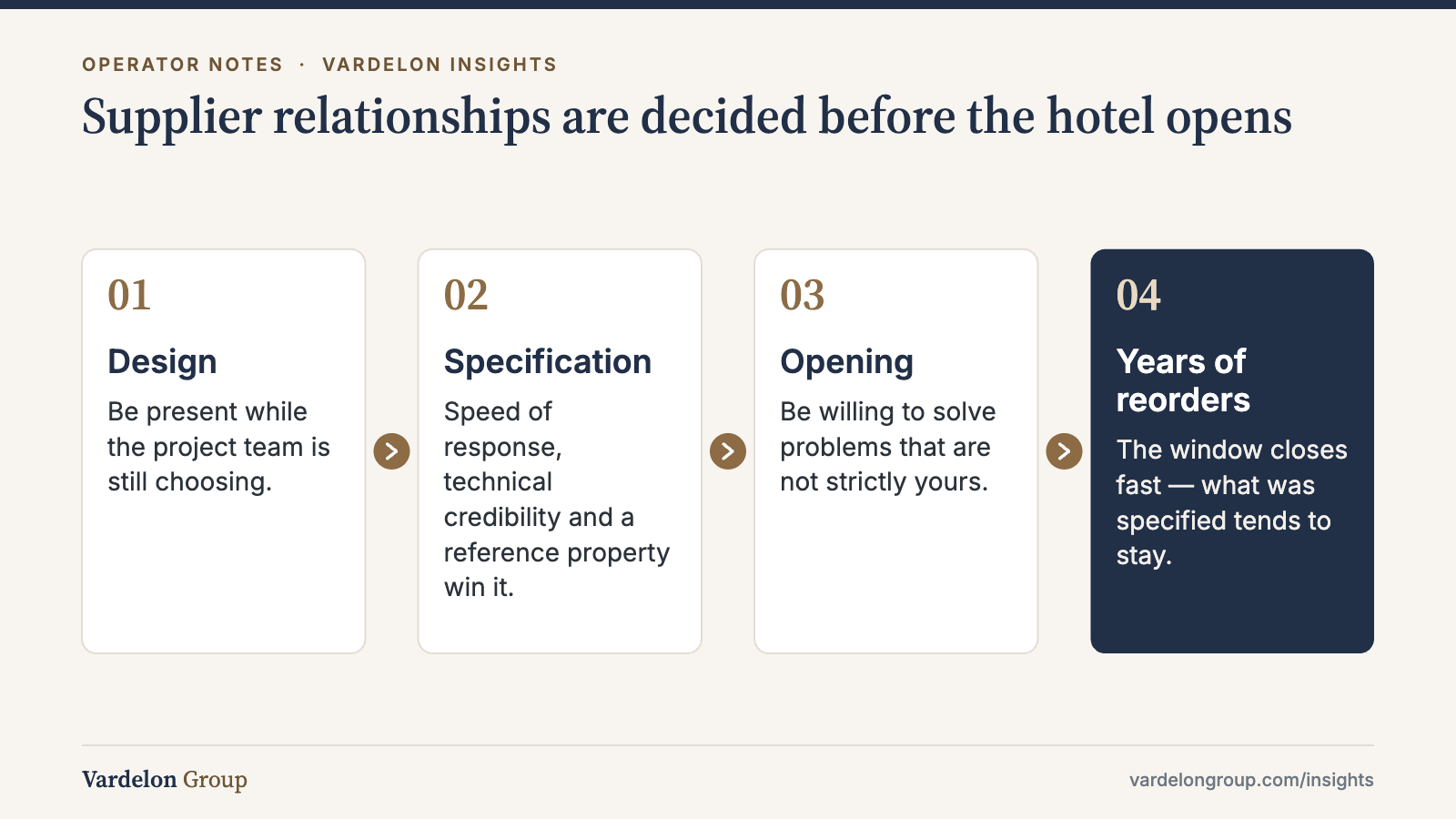
Almost everything about a property’s supply chain is decided in a compressed window: the equipment, the chemical system, the linen specification, the crockery, the technical service partner. After opening, the operation stabilises and changing any of it becomes a project nobody has time for.
This makes openings the single highest-leverage moment in hospitality supply, and it explains a great deal about how the industry is structured.
Why the window closes so fast
Once a property is trading, the cost of change is not the price difference. It is retraining staff, requalifying specifications, absorbing risk during a live operation, and finding someone with the authority and appetite to run it.
There is rarely a moment when a functioning hotel decides to review its dosing system for fun.
What actually wins the specification
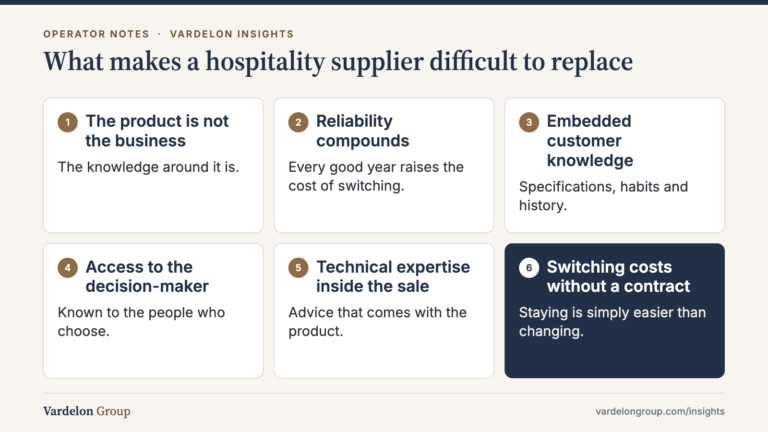
- Being present during design. The supplier consulted while the kitchen layout is drawn is frequently the one specified.
- Speed of response. Pre-opening timelines slip; the supplier who can still deliver wins.
- Technical credibility with the project team. Consultants and contractors specify what they trust.
- A reference property. Somewhere the operator can go and look.
- Willingness to solve a problem that is not yours. The supplier who fixes something outside their scope is remembered.
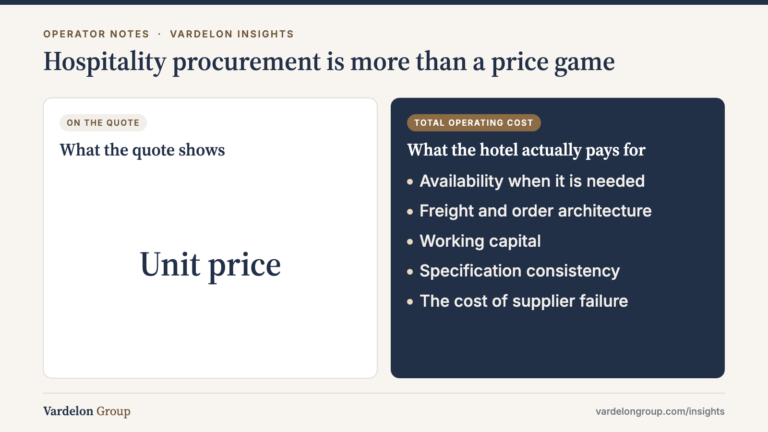
Price matters, but rarely decides. Nobody wants to explain a failure two weeks before opening in order to have saved a few per cent.
Where the relationships are formed
Often not with the hotel at all. Project consultants, kitchen designers, general contractors and owners’ representatives shape the specification long before an operator’s procurement function is involved.
A supplier with strong relationships in that layer has a pipeline that is invisible in its customer list. This is one of the things worth understanding about a business that is otherwise hard to explain from its accounts.
Why this matters for regional strategy
Hotel groups increasingly develop across several markets with common brand standards. A supplier that can serve a project in one country and then be credible for the next one in another has an advantage that compounds.
Equally, a purely national supplier can be designed out of a regional programme without ever competing on price — simply because it was not on the list when the standard was set.
The practical implication
Openings and major refurbishments are worth tracking as a distinct pipeline, separate from customer accounts. They are lumpy, they are slow, and they set up the recurring revenue described in the installed base.
A supplier that only sells to properties already trading is competing for the hardest revenue in the industry.