What Diligence Misses in Distribution Businesses
Financial and legal diligence on a distribution business is well covered by people who do it professionally. The commercial questions that decide the outcome frequently are not.
A data room will tell you revenue, margin, working capital, contracts, litigation and tax position. All necessary. None of it answers the question that matters most: will this business still be working in three years, under different ownership?
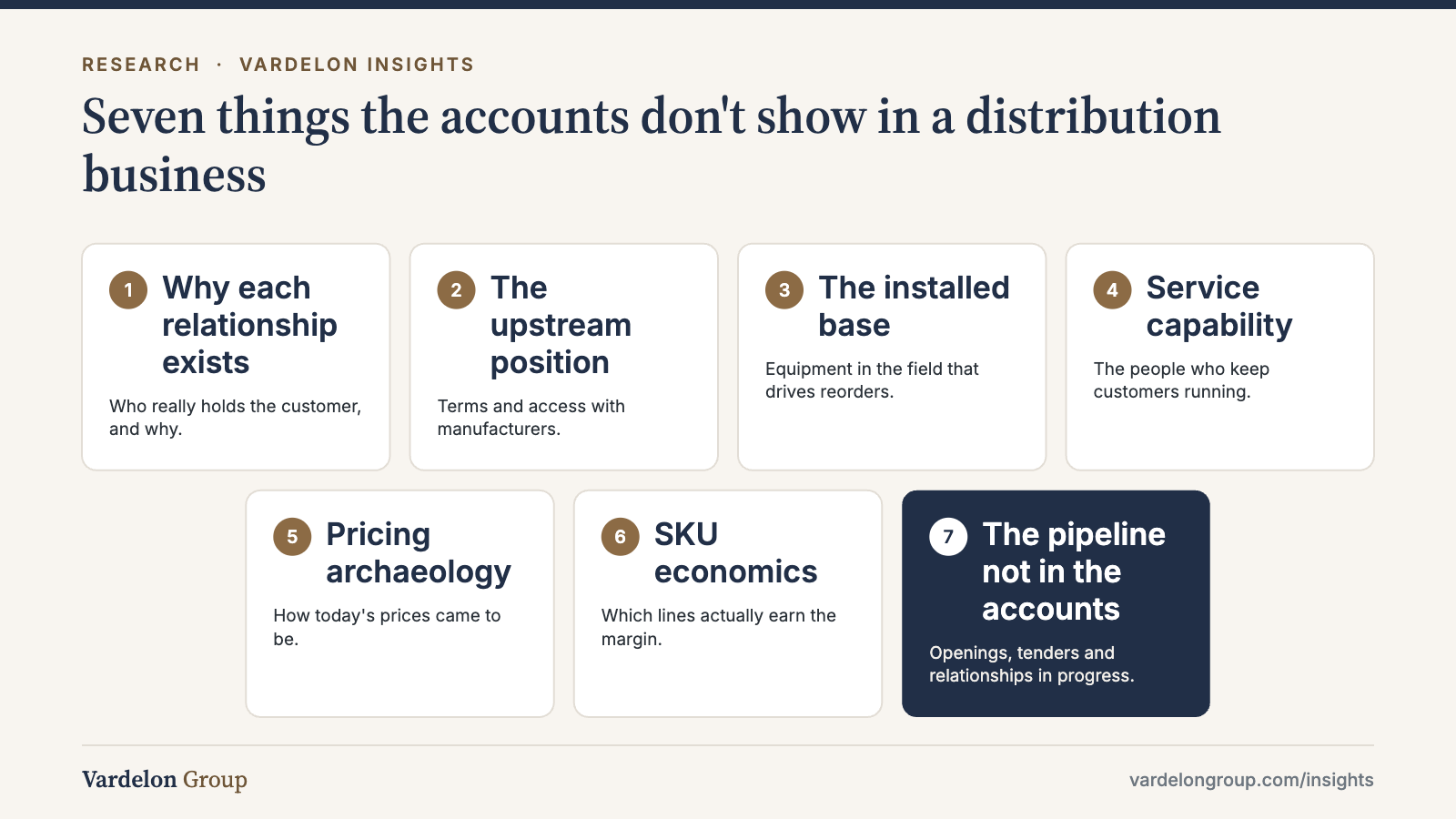
These are the areas we think deserve more attention than they usually get.
Why each relationship exists
Revenue concentration is standard analysis. Revenue quality is not. For the top twenty customers: who holds the relationship, how long has it existed, has it been tested, and what would happen if the individual who holds it left?
A business where the founder personally holds the top ten accounts is a different asset from one where a commercial team does, at identical revenue.
The upstream position
Distribution agreements, exclusivity, notice periods and change-of-control clauses. A manufacturer considering a territory restructure may treat a sale as the natural moment. This can be the largest single risk in the transaction and it sits outside the customer analysis entirely.
The installed base
Where equipment is involved: how many units, at which properties, of what age, on what service arrangement. This is the forward revenue, and most businesses cannot produce the number without a week of work — which is itself informative.
Service capability
How many technicians, how experienced, how replaceable. In service-intensive categories, three people leaving can do more damage than losing a customer. Their tenure, age profile and contractual position deserve more attention than they receive.
Pricing archaeology
Comparable customers paying materially different prices, permanent discounts nobody can explain, and prices that have not moved through several cost cycles. Each is both a risk and, handled carefully, an opportunity.
SKU economics
What share of lines produce what share of margin, and how much working capital sits in the tail. Aggregate inventory value tells you little; the distribution of it tells you a lot.
The pipeline that is not in the accounts
Relationships with project consultants, contractors and designers that generate specification decisions years ahead. Genuine and completely invisible in historical revenue.
What the second layer actually decides
Not the org chart — the reality. Who can authorise a discount, release credit, commit a delivery date, or resolve a complaint without asking the owner? The answer predicts how the business behaves in the first year after completion better than almost anything else.
Why this is not a longer checklist
It is a different kind of work. These answers come from conversations with people who run the business, not from documents. That takes longer, requires the seller’s cooperation, and cannot be outsourced entirely.
It is also the part that determines whether the thing you bought is the thing you thought you were buying. Related: What makes a B2B business worth owning →